
Table of Contents
- Why AI Automation Matters for Roofing Contractors
- How We Evaluated These AI Automation Solutions
- 10 Best AI Automation Tools for Roofing Companies
- 1. JobNimbus: Automated Lead Qualification & Voice Agents
- 2. AccuLynx: AI-Powered Lead Scoring & Predictive Analytics
- 3. Hover: Aerial Roof Measurements & Damage Detection
- 4. QuoteIQ: All-in-One Automation with Affordable Pricing
- 5. EagleView One: High-Resolution Aerial Intelligence
- 6. Rooftops AI: Fast Satellite Estimates & Proposal Generation
- 7. Airteam: Drone-Based 3D Modeling for Precision Projects
- 8. LEADSORBIT: Speed-to-Lead & Automated Customer Journeys
- 9. Reworked.ai: Predictive Lead Targeting & Market Analysis
- 10. Uberwood Agency: Fully Managed Custom AI Systems
- Feature Comparison Table: AI Tools for Roofing Automation
- How to Implement AI in Your Roofing Business: Step-by-Step
- AI Implementation Roadmap for Small Roofing Contractors
- Cost-Benefit Analysis: ROI of AI Automation for Roofers
- Data Privacy & Ethics: Protecting Customer Information
Last Updated: July 15, 2026
Why AI Automation Matters for Roofing Contractors
AI automation is essential for roofing contractors competing in a digital market. Roofing businesses using AI tools see dramatic improvements in lead response times, estimation accuracy, and crew scheduling efficiency. Manual processes don't scale, a single lead might require days of site visits, measurements, and follow-ups. AI automation collapses this timeline from weeks to hours.
How We Evaluated These AI Automation Solutions
Our selection was based on three criteria: practical impact on roofing workflows, ease of integration with existing systems, and real-world adoption by contractors. We focused on solutions addressing the biggest pain points: lead generation and qualification, accurate roof measurements, automated customer communication, and efficient job scheduling.
The 10 solutions below represent the most mature, accessible, and effective AI automation tools currently available to roofing contractors.
10 Best AI Automation Tools for Roofing Companies
1. Uberwood Agency, Fully Managed Custom AI Systems
Uberwood Agency designs custom AI systems tailored to your specific processes, integrating with existing CRMs and automating voice-based lead qualification, estimates from aerial imagery, and customer communication. Unlike off-the-shelf tools, the fully managed model means Uberwood handles setup, training, and optimization while your team focuses on closing deals.
Best For: Roofing companies scaling from 5 to 50+ crews without managing multiple tools.
Pros:
- Fully managed, end-to-end solutions
- Custom AI tailored to your workflow
- All services under one roof
Cons:
- Pricing depends on scope; contact for a quote
2. JobNimbus, Automated Lead Qualification & Voice Agents
JobNimbus is the most popular CRM in roofing. AssistAI handles inbound calls 24/7, qualifying leads and booking inspections automatically. Scout AI enables voice-command field operations. Lead scoring prioritizes high-intent prospects, and automated follow-up sequences nurture leads over time.
Best For: Roofing contractors already using JobNimbus or considering migration. Teams with 10+ crew members.
Pros:
- Deep integration with roofing workflows
- Strong automation and lead nurturing
- Industry-standard platform
Cons:
- Expensive for smaller teams
- Steeper learning curve
3. AccuLynx, AI-Powered Lead Scoring & Predictive Analytics
AccuLynx uses predictive AI to identify which leads are most likely to close and at what price point. Instead of treating all leads equally, your sales team prioritizes the 20% most likely to convert. The system flags deals at risk and recommends follow-up actions.
Best For: Mid-to-large residential roofing companies managing 50+ leads per month.
Pros:
- Data-driven lead prioritization
- Comprehensive project management
- Strong insurance workflow integration
Cons:
- Steep learning curve
- May be overkill for fewer than 30 leads monthly
4. QuoteIQ, All-in-One Automation with Affordable Pricing
QuoteIQ delivers comprehensive automation at a fraction of enterprise CRM costs. AI Autopilot generates estimates and invoices automatically. MapMeasure Pro provides satellite roof measurements. Virtual call teams handle lead responses, and automated follow-up campaigns nurture prospects.
Best For: Solo operators and small crews (2-5 people) seeking affordable all-in-one automation.
Pros:
- Very competitive pricing starting at $29.99/month
- Unlimited satellite measurements
- Simple setup and intuitive interface
Cons:
- Limited advanced enterprise features
- Less customization than higher-tier platforms
5. EagleView One, High-Resolution Aerial Intelligence
EagleView One is the industry standard for aerial roof measurements and damage detection. The platform uses high-resolution satellite imagery and AI to identify roof damage, measure square footage with precision, and extract property intelligence data.
Best For: Roofers and insurance adjusters requiring highly accurate reports. Contractors in high-storm regions.
Pros:
- Industry-standard accuracy
- Extensive property data library
- Seamless integration with industry software
Cons:
- Primarily focused on data and reports
- Per-report pricing adds up for high-volume users
6. Rooftops AI, Fast Satellite Estimates & Proposal Generation
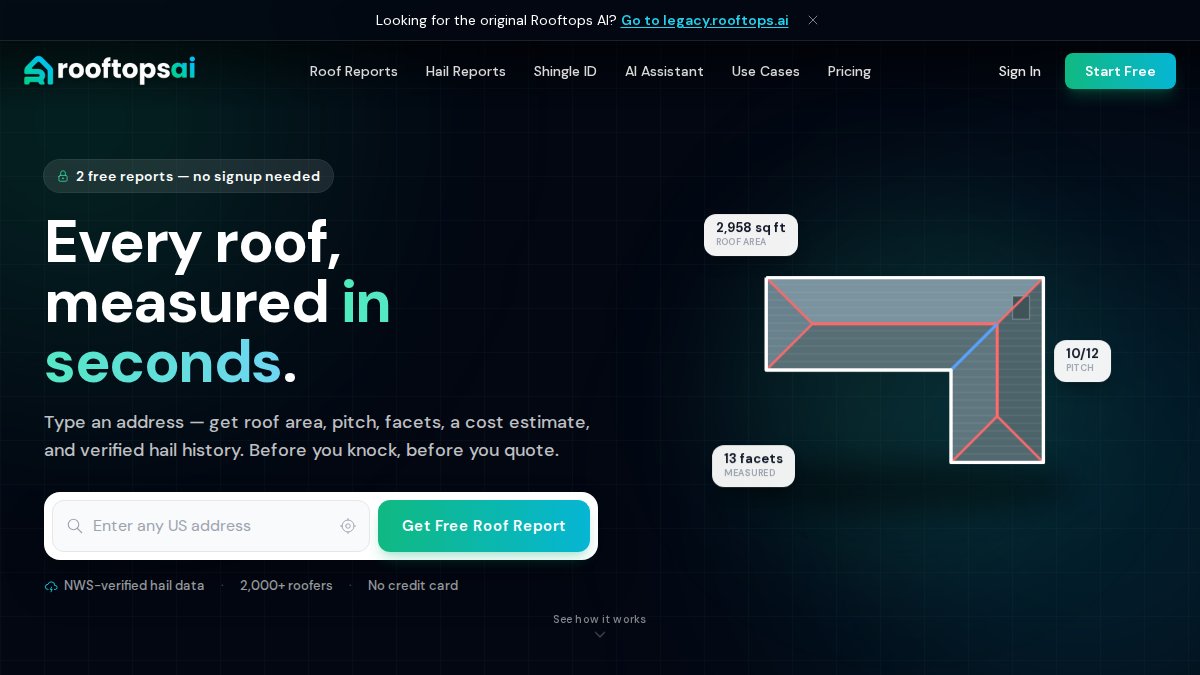
Rooftops AI generates roof estimates within minutes using satellite imagery, pitch analysis, and shingle identification. The one-click proposal builder turns estimates into professional documents ready to send.
Best For: Contractors needing fast automated estimates without manual tracing.
Pros:
- Extremely fast turnaround
- User-friendly interface
- Free tier available
Cons:
- Less comprehensive than full-suite CRMs
- May not handle complex roof geometries as accurately
7. Airteam, Drone-Based 3D Modeling for Precision Projects
Airteam uses drone imagery and AI to create centimeter-accurate 3D roof models. For high-value projects or complex geometries, this precision is invaluable. The system exports data compatible with industry software and enables teams to plan jobs in 3D before crews arrive.
Best For: Roofers handling high-precision projects or complex geometries.
Pros:
- High precision for complex roofs
- Safe, ground-based inspection workflow
- Exportable data for team planning
Cons:
- Requires drone flight or third-party pilot
- Higher cost per project than satellite alternatives
8. LEADSORBIT, Speed-to-Lead & Automated Customer Journeys
LEADSORBIT responds to inbound leads in under 1 minute, books inspections automatically, and routes jobs to the right crews. Automated proposal tracking and e-signatures keep deals moving. The system also automates re-engagement campaigns targeting past customers.
Best For: Growth-minded contractors focused on lead conversion and pipeline velocity.
Pros:
- Focuses on speed-to-lead and conversion
- Automates entire customer journey
- Strong re-engagement capabilities
Cons:
- Less well-known than major CRM incumbents
- May require integration work
9. Reworked.ai, Predictive Lead Targeting & Market Analysis
Reworked.ai identifies homeowners most likely to need roof replacement using AI analysis of aerial imagery and property data. It integrates with EagleView imagery and uses predictive modeling to score neighborhoods by "readiness to buy."
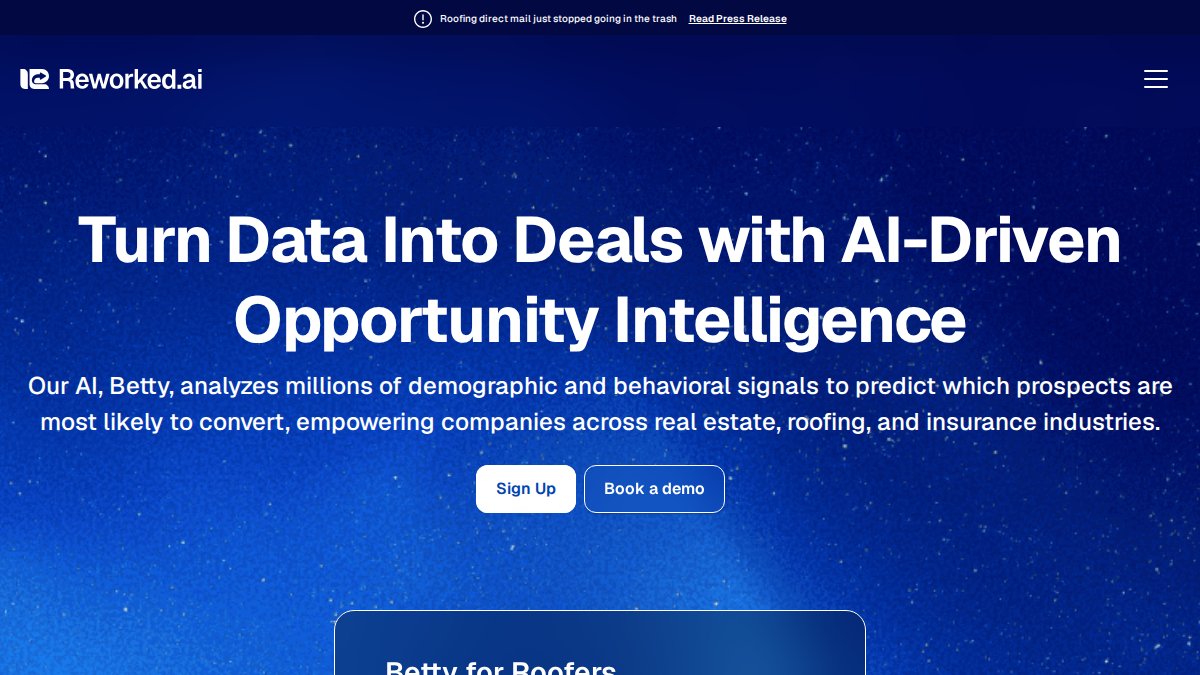
Best For: Roofing companies building high-probability lead lists for targeted marketing.
Pros:
- Highly targeted lead identification
- Reduces wasted marketing spend
- Integration with EagleView imagery
Cons:
- Requires integration with existing sales processes
- Works best as lead generation tool, not complete CRM
10. Hover, AI-Powered 3D Models from Smartphone Photos
Hover transforms smartphone photos into precise 3D models and measurements. Unlike satellite-based tools, it works from ground-level photos, ideal for inspectors already visiting properties. Integration with JobNimbus and AccuLynx means measurements flow directly into your CRM.
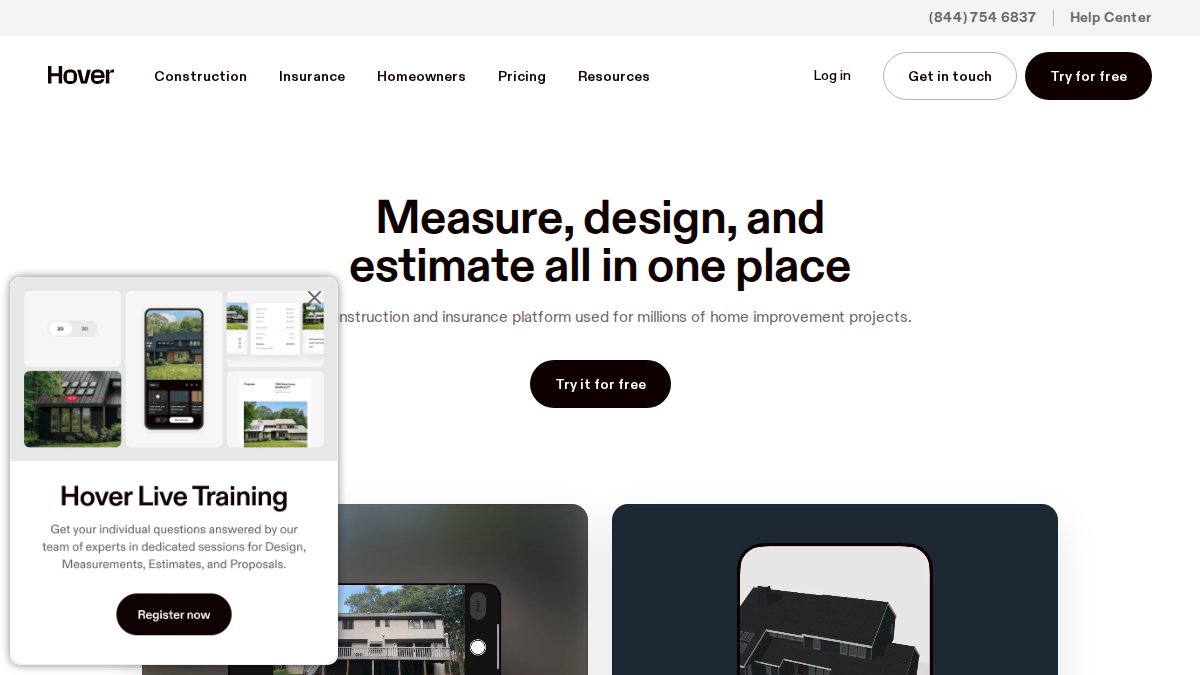
Best For: Contractors conducting on-site inspections who want accurate measurements without manual tools.
Pros:
- Industry-leading measurement accuracy
- Reduces need for multiple site visits
- Seamless CRM integration
Cons:
- Per-report cost adds up for high-volume users
- Requires on-site photo capture
Feature Comparison Table: AI Tools for Roofing Automation
| Tool | Starting Price | Lead Qualification | Aerial Measurements | Automated Estimates | CRM Integration | Best For |
|---|---|---|---|---|---|---|
| Uberwood Agency | Custom quote | ✓ Voice agents | Custom integration | ✓ Custom | ✓ Full integration | Custom AI systems |
| JobNimbus | $200+/month | ✓ AssistAI | Third-party tools | ✓ Built-in | ✓ Native | Enterprise teams |
| AccuLynx | $200+/month | ✓ Predictive scoring | Third-party tools | ✓ Built-in | ✓ Native | Mid-large companies |
| QuoteIQ | $29.99/month | ✓ Virtual team | ✓ MapMeasure Pro | ✓ AI Autopilot | ✓ Integration | Solo operators |
| EagleView One | $25-$50/report | Limited | ✓ High-resolution | ✓ Damage detection | ✓ Integration | Damage assessment |
| Rooftops AI | Contact pricing | Limited | ✓ Satellite | ✓ Fast estimates | ✓ Integration | Speed-focused teams |
| Airteam | Contact pricing | Limited | ✓ Drone 3D models | ✓ Precision estimates | ✓ Export | Complex projects |
| LEADSORBIT | Contact pricing | ✓ Automated response | Limited | ✓ Proposal automation | ✓ Integration | Lead velocity |
| Reworked.ai | Contact pricing | ✓ Predictive targeting | ✓ EagleView data | Limited | ✓ Integration | Lead generation |
| Hover | $30-$100/report | Limited | ✓ Ground-level 3D | ✓ Auto measurements | ✓ Integration | On-site inspectors |
How to Implement AI in Your Roofing Business: Step-by-Step
Phase 1: Audit Your Current Workflow & Pain Points
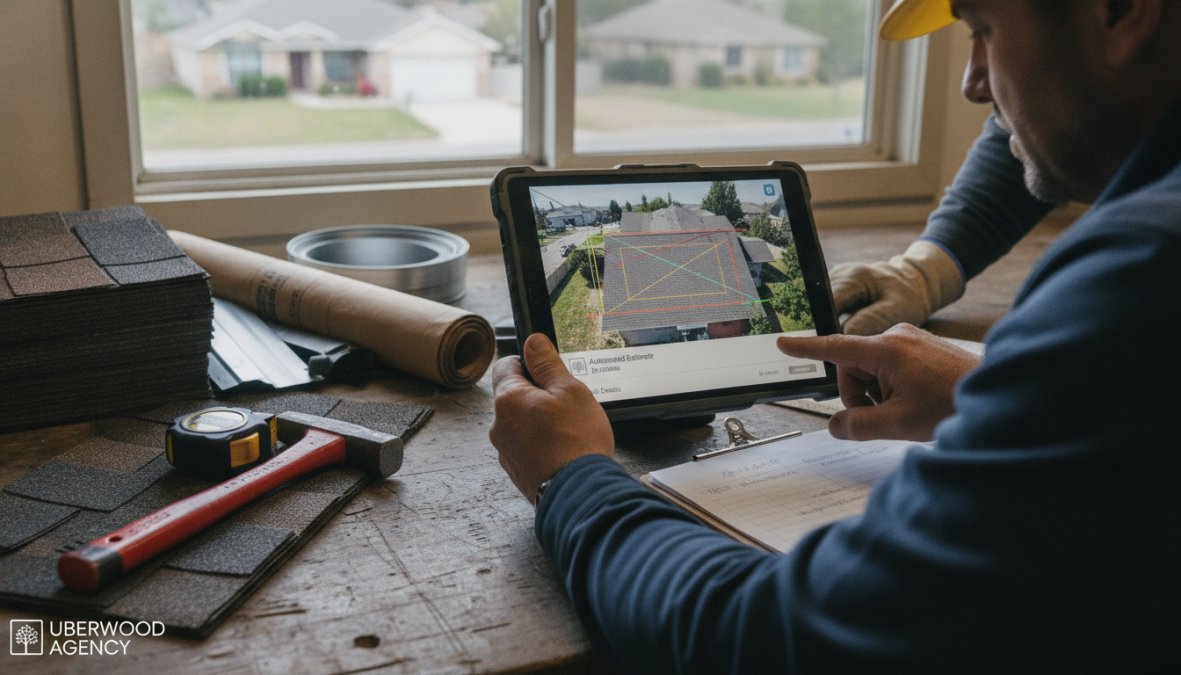
Map your process from lead capture to job completion. Where do you lose the most time? Most contractors identify one bottleneck: slow lead response, manual measurement, or proposal delays. Document your current timeline and which tasks consume the most crew time.
Phase 2: Select Tools That Solve Your Top 2-3 Problems
Don't implement everything at once. If your biggest problem is slow lead response, start with a voice agent. If it's measurement accuracy, begin with aerial imagery software. Solving your top pain point first builds momentum and shows your team the value of automation.
Phase 3: Test Integration with Your Existing CRM
Before full deployment, test how new tools integrate with JobNimbus, AccuLynx, or your current CRM. Does lead data flow automatically? Do estimates sync into proposals? Poor integration creates more work, not less.
Phase 4: Train Your Team & Monitor Early Metrics
Brief training sessions (15-30 minutes) are usually sufficient. Track metrics obsessively: response time, proposal turnaround, conversion rate, and administrative hours. After two weeks, you should see measurable improvements.
AI Implementation Roadmap for Small Roofing Contractors
Month 1: Foundation (Lead Response) Deploy a voice agent or automated lead response system. This reduces response time from hours to minutes, directly improving conversion rates.
Month 2-3: Measurement (Aerial Intelligence) Add satellite or drone-based measurements. Your team spends less time on inspections and more time closing deals.
Month 4-6: Estimation (Automated Proposals) Integrate automated estimate generation. Compress your sales cycle from days to hours.
Month 6+: Optimization (Predictive Analytics) Layer in predictive analytics to identify which leads are most likely to close. Small contractors following this roadmap typically see 40-60% reduction in administrative time within three months.
Cost-Benefit Analysis: ROI of AI Automation for Roofers
A solo contractor implementing QuoteIQ ($29.99/month) plus Rooftops AI estimates ($0.50-$2 per estimate) spends roughly $100-150 monthly. If automation reduces estimate time from 4 hours weekly to 1 hour, that's 12-15 hours freed monthly. At $150/hour value, monthly savings equal $1,800-2,250. ROI is achieved within the first month.
A 5-crew operation implementing JobNimbus ($200+/month) plus EagleView ($300-500/month) invests roughly $500-700 monthly. If automation improves conversion rates 15-25%, a company closing 2 jobs weekly at $8,000 average ticket gains $24,000 in additional monthly revenue. ROI is achieved in the first week.
Data Privacy & Ethics: Protecting Customer Information
Aerial imagery, property data, and customer contact information are sensitive. Ensure any tool complies with data protection standards. Voice agents that record calls require explicit customer consent in many states. Customer data should never be shared with third parties without explicit consent. Store data securely with encryption and regular security updates.
Frequently Asked Questions
How can AI automation help roofing companies improve profitability?
AI automation reduces operational costs by automating lead follow-up, estimates, and scheduling. Tools like JobNimbus and AccuLynx handle routine customer communication 24/7, freeing your team to focus on closing deals. Automated estimates and damage detection cut the time spent on site visits and proposal generation. By streamlining these workflows, roofing contractors typically see faster conversion rates and better crew dispatch optimization, directly improving bottom-line profitability.
What is the best AI roofing estimation software for small contractors?
QuoteIQ and Rooftops AI are excellent for small teams due to affordable pricing and ease of use. QuoteIQ starts at $29.99/month and includes unlimited satellite measurements plus AI-powered estimates. Rooftops AI offers a free tier and instant satellite roof measurements with automated proposal generation. For contractors wanting fully managed support, Uberwood Agency provides custom AI builds tailored to your specific workflow without requiring in-house technical expertise. Choose based on your budget and preference for DIY versus done-for-you solutions.
How do I implement AI automation in my roofing business without disrupting current operations?
Start by auditing your biggest pain points, typically lead response time, estimate generation, or scheduling. Select one or two tools that solve those problems first, then test integration with your existing CRM before rolling out to your full team. Phase your implementation: begin with a pilot group, train them thoroughly, and measure results over 30 days. Most integration challenges arise from poor data mapping, so work with your software provider to ensure clean data flow. Gradual rollout minimizes disruption while proving ROI to your team.
Is automated lead follow-up for roofers effective for customer retention?
Yes. Tools like LEADSORBIT and JobNimbus respond to leads in under 1 minute and automate nurturing sequences, significantly improving conversion rates. Automated follow-up also re-engages past customers for repeat business. However, personalization matters, generic automation can feel cold. The most effective approach combines AI-powered speed (instant responses, smart scheduling) with human touchpoints (a crew member calls to confirm details). This hybrid method maintains the efficiency of automation while preserving the relationship-building that roofing customers value.
What are the main integration challenges when adopting AI automation for roofing?
Common challenges include data silos (information scattered across multiple systems), API compatibility issues with older CRM platforms, and team resistance to change. Poor data quality can cause AI tools to produce inaccurate leads or estimates. Start by auditing your current data structure and confirming API support before purchasing. Many vendors offer migration support, but budget time for testing. Working with a managed AI provider like Uberwood Agency can eliminate technical complexity by handling integration and ongoing optimization under one roof.
This article was written using GrandRanker