
Table of Contents
- Quick Comparison: Top AI Chatbots for Ecommerce Stores
- How We Selected These Platforms
- 1. Tidio: Best for Visual Chatbot Building
- 2. Gorgias: Best for High-Volume Shopify Stores
- 3. Intercom: Best for Proactive Customer Engagement
- 4. LiveChat AI: Best for Quick Deployment
- 5. ManyChat: Best for Social Commerce
- AI Chatbot Implementation Best Practices for Ecommerce
Best AI Chatbots for Ecommerce Stores: 2026 Buyer's Guide
Last Updated: August 4, 2026
Quick Comparison: Top AI Chatbots for Ecommerce Stores
When evaluating the best AI chatbots for ecommerce stores, the decision comes down to your business model, integration requirements, and support volume. At Uberwood Agency, we've analyzed the landscape to help ecommerce founders select tools that move the needle on conversion and customer retention.

| Tool | Starting Price | Free Tier | Best For | Key Strength |
|---|---|---|---|---|
| Tidio | $29/month | Yes (limited) | Visual chatbot builders | Ease of use + Shopify integration |
| Gorgias | $10/month | No | High-volume Shopify stores | Deep ecommerce platform integration |
| Intercom | $29/seat/month | No | Proactive engagement | AI-powered conversation resolution |
| LiveChat AI | $39/month | Yes (limited) | Quick deployment | Unlimited data sources for training |
| ManyChat | $14/month | Yes (limited) | Social commerce | Multi-channel automation |
How We Selected These Platforms
The best AI chatbots for ecommerce stores integrate seamlessly with your tech stack, reduce response time without sacrificing quality, and scale without doubling support costs. We weighted integration depth heavily because a chatbot disconnected from your order system, inventory, or CRM creates more work, not less.
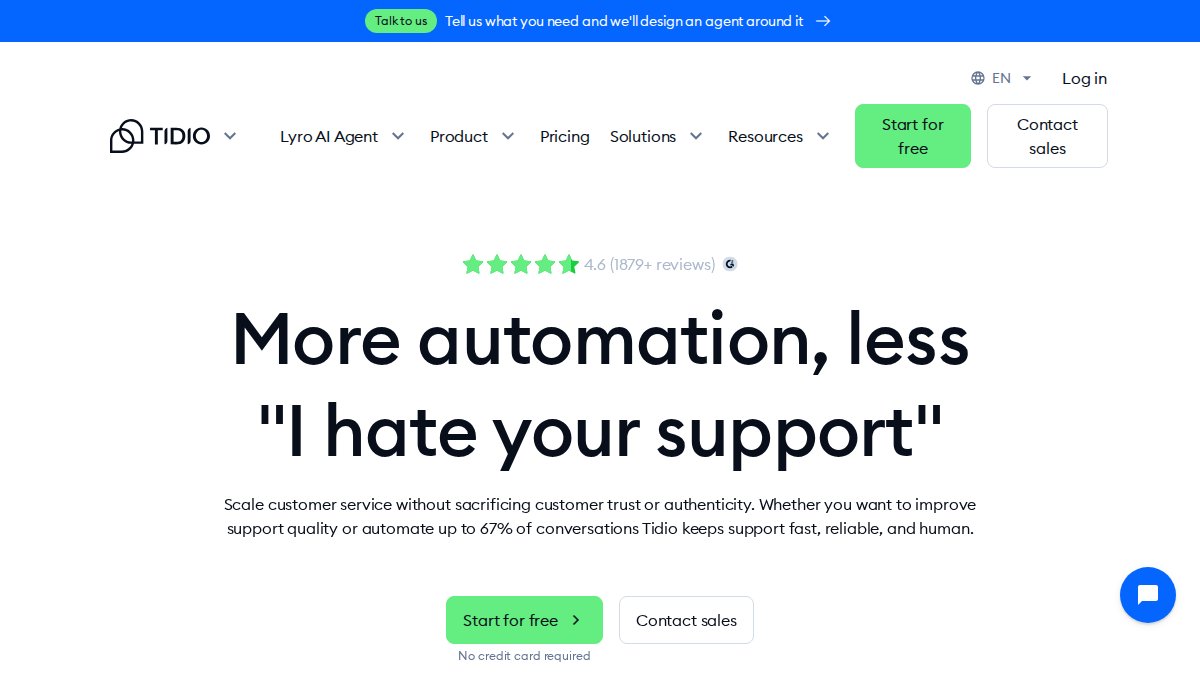
1. Tidio: Best for Visual Chatbot Building
Tidio removes the coding barrier entirely. You build conversation flows by dragging and dropping decision trees. For store owners without technical resources, this matters significantly.
The platform combines live chat, chatbots, and email marketing in one interface. Lyro AI, their GPT-powered agent, can be trained on your website content to handle product questions, shipping inquiries, and policy clarifications.
Integration with Shopify is native. Your chatbot can pull product details, check inventory status, and process returns directly from the conversation. Pricing starts at $29/month for basic functionality, with AI features and advanced automation as add-ons.
Pros:
- Visual builder requires zero coding knowledge
- Strong Shopify integration for product lookups and order status
- Lyro AI training is straightforward
- Free plan covers basic live chat and simple bots
Cons:
- AI features are separate add-ons, inflating cost
- Conversation volume pricing escalates quickly
- Limited customization for complex workflows
2. Gorgias: Best for High-Volume Shopify Stores
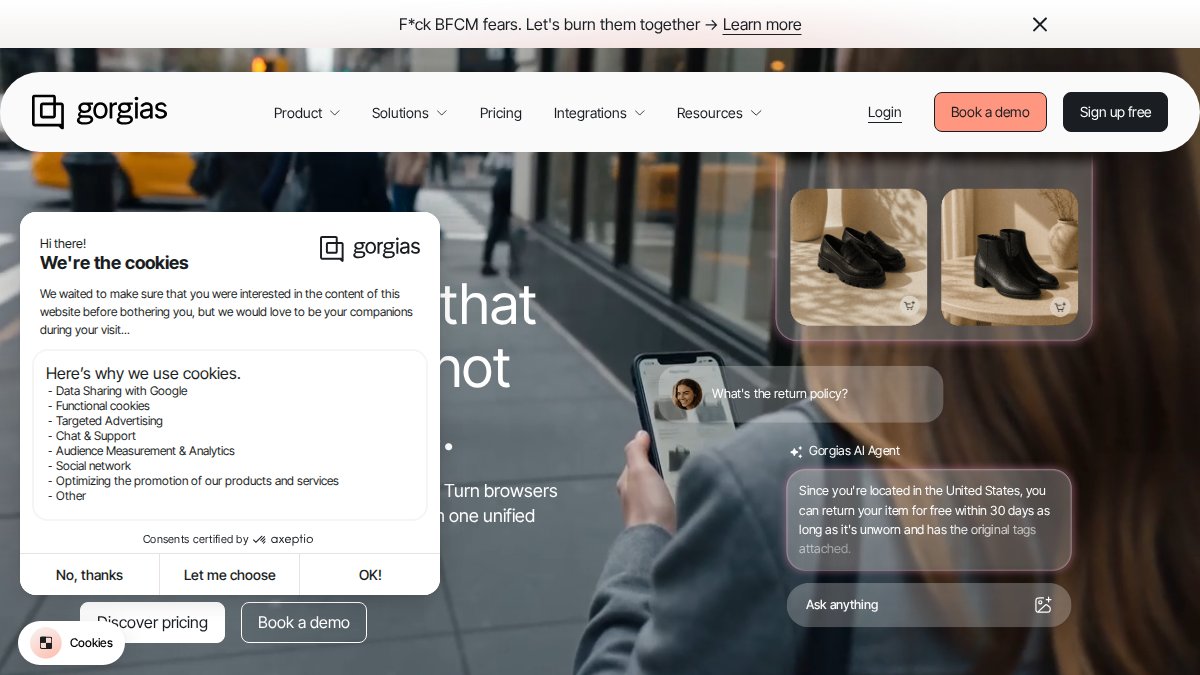
Gorgias is purpose-built for ecommerce support at scale. Every feature assumes you're managing orders, tracking shipments, and processing refunds through live chat.
The AI Agent resolves common tickets automatically: order status inquiries, shipping questions, return requests. It learns from your previous resolutions, improving accuracy over time. When escalation is needed, the conversation hands off to a human agent with full context intact.
The pricing model is unique: you pay per ticket, not per agent. This means unlimited team members can access the platform without per-seat fees. A store with seasonal spikes can scale agents up and down without renegotiating contracts.
Pricing starts at $10/month for 50 tickets monthly. A typical mid-volume store (5,000-10,000 tickets/month) pays $30-50/month.
Pros:
- Unlimited agent seats on all plans
- Deep Shopify integration pulls order data into every conversation
- AI Agent handles 30-40% of tickets without human intervention
- Omnichannel support across live chat, email, SMS, and social
Cons:
- Costs become unpredictable with fluctuating ticket volumes
- AI Agent is billed separately per resolution
- Steeper learning curve than visual builders
3. Intercom: Best for Proactive Customer Engagement
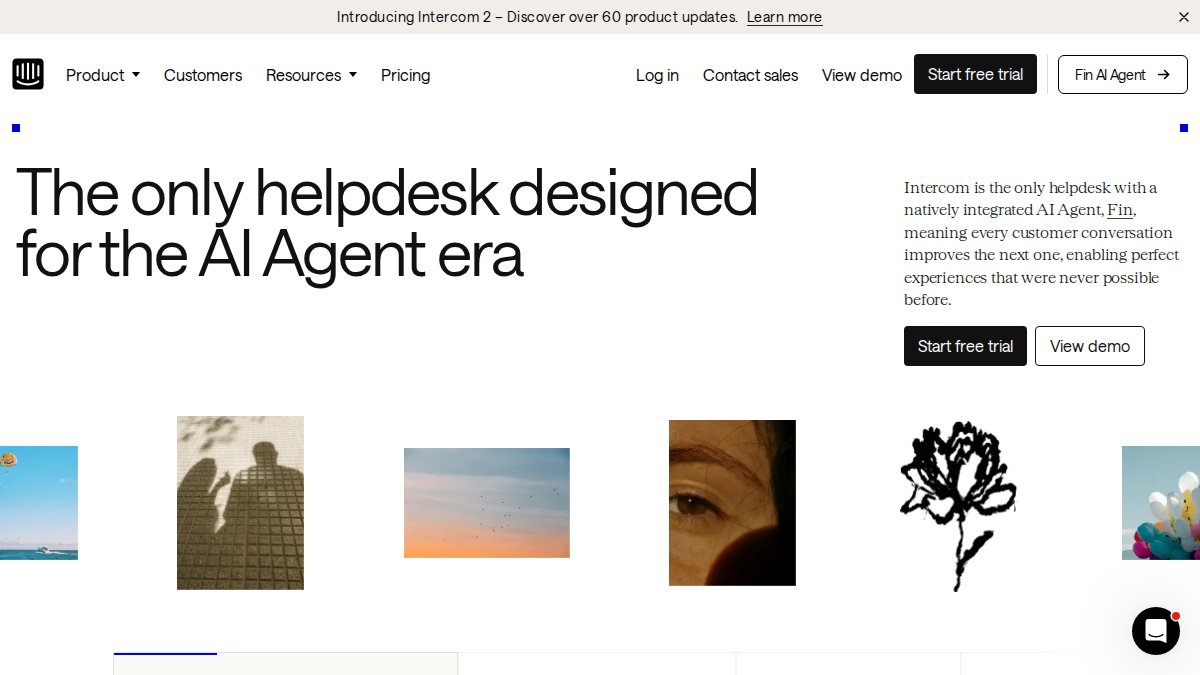
Intercom enables proactive outreach at key moments in the customer journey instead of waiting for customers to contact you.
Fin AI Agent automates conversation resolution at scale, handles multi-turn conversations, and escalates intelligently when human judgment is needed. The agent improves continuously through supervised learning as your team reviews and corrects responses.
Intercom shines in omnichannel orchestration. You can trigger targeted messages based on user behavior: cart abandonment, browsing patterns, or customer lifecycle stage. A customer who abandoned their cart sees a personalized offer. A repeat buyer gets VIP treatment.
Pricing starts at $29/seat/month for the base platform. Fin AI adds per-resolution costs on top. A typical mid-market setup runs $150-300/month.
Pros:
- Fin AI Agent handles complex conversations effectively
- Proactive messaging drives higher engagement than reactive support
- Comprehensive feature set for customer engagement beyond support
- Integrates with most ecommerce platforms and CRMs
Cons:
- Pricing is complex with per-seat + AI resolution fees
- No permanently free plan
- Overkill for small stores needing basic chatbot functionality
4. LiveChat AI: Best for Quick Deployment
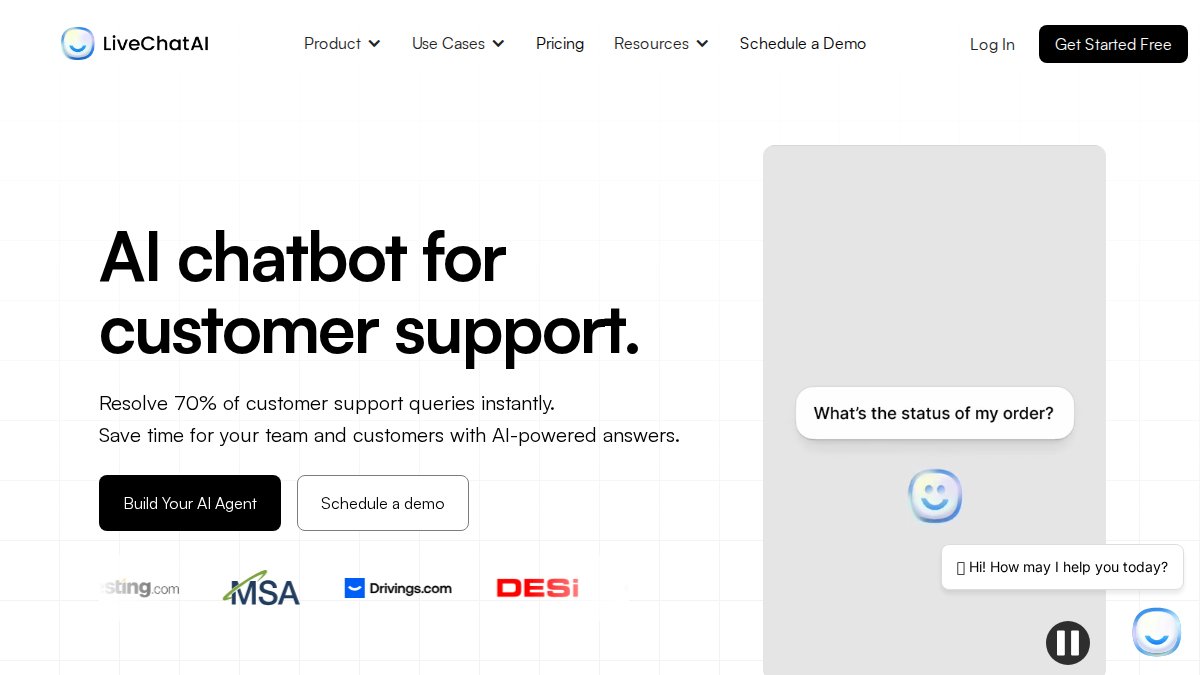
LiveChat AI prioritizes speed. You can have a trained chatbot live in hours. The platform uses your existing content, product pages, FAQs, and help documentation to train the bot automatically.
The credit-based pricing model is transparent. You purchase message credits (using GPT-4o), and each conversation consumes credits based on token usage. Bring your own OpenAI API key to reduce costs significantly.
Unlimited data sources mean the bot can be trained on up to 10 million characters of content. Pricing starts at $39/month for 4,000 message credits.
Pros:
- Free plan available to test the service
- Generous message credits with paid plans
- Unlimited data sources for comprehensive bot training
- Transparent credit-based pricing with no hidden per-resolution fees
Cons:
- Costs escalate if message credits are exceeded
- Lacks deep ecommerce platform integrations compared to Gorgias or Tidio
- Limited customization compared to enterprise platforms
5. ManyChat: Best for Social Commerce
ManyChat dominates Instagram and Facebook Messenger automation. If your primary customer acquisition channel is social media, this platform is built specifically for that workflow.
The visual flow builder creates automated sequences across Instagram DMs, Facebook Messenger, WhatsApp, Telegram, SMS, and email. Lead qualification funnels automatically segment contacts based on responses, routing ready buyers to sales and browsers to nurture sequences.
Pricing starts at $14/month for basic automation. WhatsApp messaging carries Meta's per-message fees on top. A typical mid-market setup runs $50-100/month including WhatsApp costs.
Pros:
- Free plan for basic functionality
- Strong focus on social media channels where DTC brands acquire customers
- Relatively affordable for basic automation
- Integrates with Shopify for product recommendations and order tracking
Cons:
- AI features are a separate add-on
- WhatsApp messaging fees add up quickly with high volume
- Less suited for stores relying on email or web chat as primary support channels
AI Chatbot Implementation Best Practices for Ecommerce
Rolling out a chatbot without a clear strategy leads to frustration. Start with a narrow scope. Pick your highest-volume inquiry type, order status, shipping timelines, return eligibility, and build a bot that handles that one thing exceptionally well. Once it's performing reliably, expand to additional use cases.
Train your bot on your actual data, not generic templates. Connect it to your help center, FAQ pages, and product information. A chatbot trained on your real content makes fewer mistakes and sounds authentically like your brand.
Set clear escalation rules. Some questions require human judgment: complex refunds, complaints, or requests outside standard policies. A well-designed bot recognizes these boundaries and hands off to a human agent with full context. This hybrid approach delivers better outcomes than either alone.

Monitor performance continuously. Track deflection rates, customer satisfaction scores, and resolution times. A chatbot resolving 60% of inquiries without escalation is a success. Use these metrics to identify gaps and retrain the bot.
Human-in-the-loop workflows prevent costly mistakes. Have your support team review and correct bot responses before full autonomy. This feedback improves accuracy and builds confidence. Many platforms support this directly.
Post-purchase automation captures significant value. A chatbot that proactively sends order confirmations, shipping updates, and delivery notifications reduces support volume by 20-30% on average.
The Bottom Line
The best AI chatbots for ecommerce stores aren't one-size-fits-all. Your choice depends on your platform, support volume, team size, and technical resources.
For stores prioritizing ease of use and visual workflow building, Tidio delivers the fastest path to deployment. For Shopify stores handling thousands of inquiries monthly, Gorgias' ticket-based pricing and deep integrations justify the investment. For teams focused on proactive customer engagement, Intercom's AI capabilities drive measurable revenue impact.
Many businesses find that the right chatbot implementation reduces support costs by 25-40% while improving customer satisfaction scores. The key is starting narrow, monitoring performance, and expanding systematically.
Choosing between these platforms requires understanding your specific operational needs. At Uberwood Agency, we specialize in designing and operating custom AI systems that integrate seamlessly with your existing workflows, from chatbots and voice agents to fully automated customer communication sequences. Rather than forcing your business into a generic platform's constraints, we build custom solutions tailored to your exact requirements.
If you're managing high inquiry volume and need a solution that doesn't require constant babysitting, get a free estimate quote and book a call today to discuss how custom AI automation can simplify your operations. We handle the technical engineering so you can focus on closing deals.
For more insights on customer support automation, check out HubSpot's 2026 Customer Service Benchmark Report, which documents how automation impacts response times and customer satisfaction across industries. Additionally, Gartner's research on conversational commerce shows that businesses implementing AI-powered chat see 15-20% improvements in customer retention metrics.
Frequently Asked Questions
How do AI chatbots improve ecommerce conversion rates?
AI chatbots reduce friction in the customer journey by answering questions instantly, qualifying leads, and guiding shoppers toward checkout. They provide 24/7 availability, which means potential customers get support even outside business hours. Platforms like Gorgias and Tidio use natural language processing to understand customer intent and deliver personalized responses. Many stores report faster response times and higher satisfaction scores when they deploy AI chatbots, both of which correlate with increased conversions.
What is the difference between a rule-based chatbot and an AI chatbot for ecommerce?
Rule-based chatbots follow predefined scripts and decision trees. They work well for simple, repetitive tasks but struggle when customers ask unexpected questions. AI chatbots use machine learning and natural language processing to understand context and generate contextual responses. They learn from interactions and adapt over time. For ecommerce, AI chatbots handle complex queries about product specifications, shipping, and returns more naturally, reducing the need for human escalation.
Can AI chatbots integrate with Shopify and WooCommerce?
Most modern AI chatbots integrate with major ecommerce platforms. Gorgias has deep native integration with Shopify, pulling order data directly into conversations. Tidio, Intercom, and ManyChat all support Shopify through APIs and Zapier. WooCommerce compatibility varies by platform. Before choosing, verify that your chatbot can access customer order history, product catalogs, and inventory data. Deep integrations reduce manual work and enable the chatbot to provide accurate, real-time information without requiring manual syncing.
Are AI chatbots worth the investment for small ecommerce businesses?
For small stores handling 10-50 customer inquiries daily, an AI chatbot can reduce support costs significantly by automating responses to common questions. Platforms like Tidio and ManyChat offer free or low-cost tiers ($14-29/month) that work for starter volumes. The ROI depends on your current support workload. If one person spends 10+ hours weekly answering emails and messages, a chatbot typically pays for itself within weeks. However, if you have minimal customer communication, the setup time may not justify the cost.
What implementation challenges should I expect when deploying an AI chatbot for ecommerce?
Common challenges include training the chatbot on your product data and business rules, integrating it with existing systems without breaking workflows, and managing the transition so customers understand how to interact with the bot. Many platforms require you to upload product catalogs, FAQs, and past support conversations to train the AI effectively. Human-in-the-loop workflows, where bots escalate complex issues to agents, help prevent poor customer experiences. Uberwood Agency handles these technical complexities end-to-end, managing deployment, training, and ongoing optimization so your team can focus on sales.