
Table of Contents
- What Managed AI Automation Services Pricing Actually Covers
- Common AI Automation Agency Pricing Models
- Factors That Drive the Cost of Custom AI Agent Development
- Small Business vs. Enterprise AI Automation Costs
- How to Calculate AI Automation ROI
- What to Evaluate Beyond Price: TCO, SLAs, and Exit Clauses
- Conclusion
Last Updated: August 16, 2026
What Managed AI Automation Services Pricing Actually Covers
When you're evaluating managed AI automation services pricing, you're not just paying for software, you're paying for the entire engineering, deployment, and operational overhead that keeps your AI systems running. Understanding what's included in these costs separates realistic budgeting from sticker shock.
Managed AI automation services typically bundle several components. The discovery and audit phase identifies where automation creates the most value in your workflows. System integration connects your new AI tools to existing platforms, CRM, ERP, payment systems, communication channels. Custom AI agent development builds the actual workflows tailored to your business logic. Ongoing monitoring and maintenance keeps systems performing reliably, catching issues before they impact your operations.
At Uberwood Agency, we've found that businesses often underestimate the scope of "fully managed." It means someone is responsible when your voice agent misroutes a call at 2 AM, when your chatbot needs retraining on new product information, or when API changes break an integration. That accountability costs money, but it's also what separates a managed service from a DIY platform you're left to troubleshoot yourself.
The pricing you encounter reflects these layers. A basic automation platform might charge per user or per workflow. A managed service charges for the engineering expertise, the monitoring infrastructure, the on-call support, and the customization work required to make the system work specifically for your business.
Common AI Automation Agency Pricing Models
Agencies structure their pricing around how they want to be compensated for their work. Each model reflects different assumptions about project scope, risk, and ongoing responsibility.
Monthly Retainer Model
A monthly retainer is a fixed fee paid each month for ongoing management and optimization of your automation systems. The agency commits to a certain number of hours, system uptime guarantees, and performance improvements.
Retainer pricing works well when you have continuous automation needs, regular updates to workflows, monitoring across multiple systems, and iterative improvements based on performance data. The agency benefits from predictable revenue. You benefit from consistent attention to your systems without surprises.
Retainers typically range based on scope. The engagement model determines frequency, some agencies include weekly strategy calls and monthly optimization reviews; others provide on-demand support within response-time SLAs.
The risk with retainers is that either party can feel underutilized. If your automation needs are lighter than expected, you're paying for unused capacity. If needs exceed the agreed scope, you'll face overage charges or renegotiation.
Project-Based Pricing
Project-based pricing charges a fixed fee for a defined scope of work with clear deliverables and timelines. You pay for the discovery phase, the build phase, testing, and deployment, then the project concludes.
This model suits businesses with discrete automation needs. You're building a new lead qualification workflow, integrating a voice agent into your phone system, or automating customer communication sequences. The agency scopes the work, estimates hours and complexity, and quotes a fixed price.
Project pricing offers budget certainty. You know exactly what you're paying before work begins. It also creates clear accountability, the agency commits to specific deliverables by a specific date. If they miss, that's a negotiated issue.
The limitation is that project work often reveals needs that weren't obvious during scoping. Integrations take longer than expected. Your business processes are more complex than initially described. Testing surfaces edge cases that require additional work. These scope creep scenarios are handled through change orders, which add cost and timeline delays.
Hybrid Engagement: Setup Plus Retainer
Many agencies blend models: a one-time setup fee covers discovery, build, testing, and deployment. Then a monthly retainer covers ongoing management, monitoring, and optimization.
This approach balances upfront investment with ongoing support. You know the initial cost to get the system live. You also know the monthly cost to keep it running and improving. The agency gets paid for the build work and then maintains a revenue stream from supporting it.
The hybrid model is common for mid-market and growing businesses because it acknowledges reality: automation isn't a one-time project. Systems need monitoring, workflows need refinement as business processes change, and performance optimization is continuous work. If you're considering this approach, Get A Free Estimate Quote And Book A Call Today to discuss which model aligns best with your business needs and timeline.
Factors That Drive the Cost of Custom AI Agent Development
Not all automation projects cost the same. Several variables determine whether your bill lands at the lower or higher end of the spectrum.
System Integration Complexity
The number of systems your AI agents need to connect to directly impacts cost. A simple chatbot that answers FAQs and collects contact information requires minimal integration. A voice agent that needs to check inventory, verify customer history in your CRM, process payments, and route calls to the right department is exponentially more complex.
Each integration point introduces technical debt. Your CRM might have an API, but that API might have rate limits, authentication requirements, or data format quirks that require custom mapping. Your payment processor might not integrate cleanly with your automation platform. Legacy systems might require middleware or workarounds.
Integration complexity also affects ongoing maintenance. The more systems connected, the more potential points of failure. When your CRM updates its API, your automation might break. When your phone system changes, your voice agent might stop routing calls correctly. Agencies price this risk into their estimates.
AI Audit and Discovery Phase
Before building anything, a reputable agency conducts discovery. This phase maps your current workflows, identifies bottlenecks, quantifies the opportunity, and recommends where automation creates the most value.
Discovery isn't free. It involves interviews with your team, analysis of your current processes, review of your tech stack, and documentation of your business logic. A thorough discovery phase takes weeks and involves multiple stakeholders.
The depth of discovery affects both the initial cost and the quality of the final system. A shallow discovery might miss critical workflows or edge cases. A thorough discovery uncovers complexity that informs realistic scoping and budgeting.
Ongoing Maintenance and Monitoring
After deployment, your automation systems need monitoring. Are workflows completing successfully? Are error rates climbing? Is the AI agent handling edge cases correctly, or is it starting to hallucinate responses?
Maintenance includes regular reviews of system performance, proactive identification of issues, updates when business processes change, and retraining when new data or new use cases emerge. An agency monitoring your systems catches problems before they impact your customers.
The cost of monitoring and maintenance depends on the complexity of your systems and the SLAs you require. A system that needs 99.9% uptime with 15-minute response times for critical issues costs more to maintain than a system with looser availability requirements.
Small Business vs. Enterprise AI Automation Costs
The scale of your operation fundamentally changes automation costs. A plumbing company with 20 incoming calls daily has different needs than a national home services franchise with 1,000 daily calls across multiple regions.
Small businesses often benefit from simpler automation. A voice agent handling call screening and appointment booking. A chatbot answering common questions and collecting leads. These focused use cases have lower integration complexity and faster deployment.

Enterprise organizations manage automation at scale. Multiple departments using different systems. Hundreds of workflows requiring coordination. Strict compliance and security requirements. Complex integrations across legacy systems and modern platforms.
Enterprise projects require deeper discovery, more extensive testing, stronger security controls, and more sophisticated monitoring. The engineering work is substantially larger. The risk of failure is higher because more business operations depend on the systems working correctly.
Cost scales with complexity, but not linearly. A small business might pay for a few weeks of engineering work and a modest monthly retainer. An enterprise might invest months of engineering and a substantial retainer covering a dedicated team.
How to Calculate AI Automation ROI
Understanding ROI is critical because automation costs money upfront but should generate returns over time. The calculation looks straightforward, savings minus costs, but the details matter.
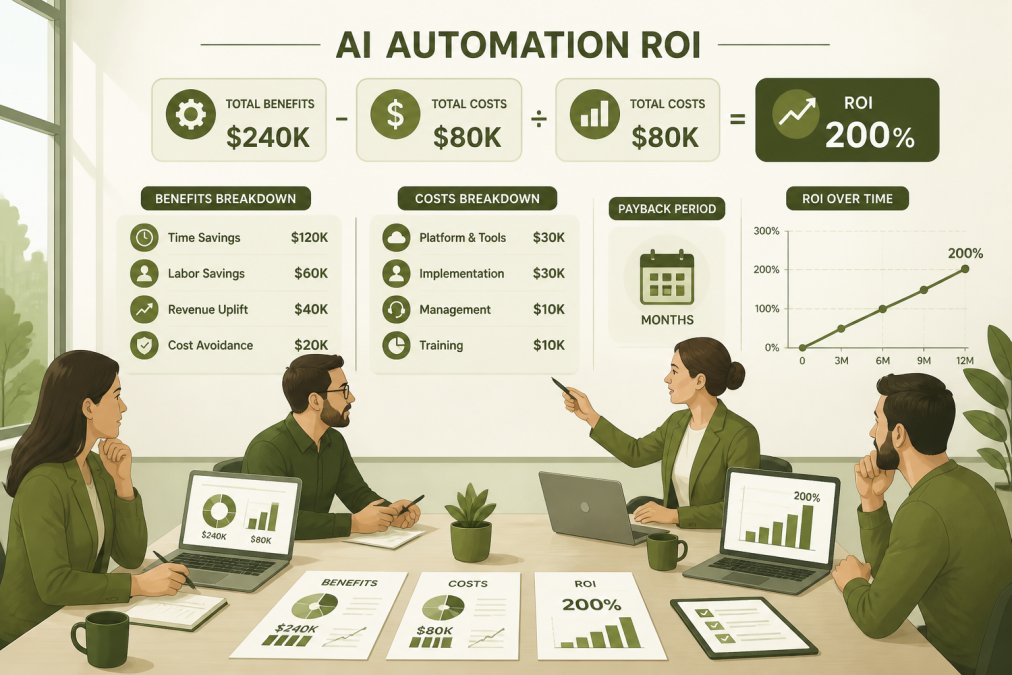
Start by quantifying what automation replaces. If a voice agent handles incoming calls, measure the current cost of that labor. If a chatbot qualifies leads, measure the time your team currently spends on qualification. If an automation sequences customer communication, measure the hours spent on manual outreach.
Next, estimate the percentage of work the automation actually handles. A voice agent might handle 80% of incoming calls, with 20% requiring human escalation. A chatbot might qualify 60% of leads, with 40% requiring sales follow-up. These percentages determine your actual labor savings.
Calculate the monthly savings. If your voice agent handles 80% of 600 monthly calls that currently cost $15 per call to handle manually, that's 480 calls × $15 = $7,200 monthly savings. If your automation costs $2,000 monthly to operate and maintain, your net monthly benefit is $5,200.
The payback period is the upfront investment divided by monthly benefit. If your setup cost $30,000 and your monthly benefit is $5,200, payback occurs in about 6 months. After that, you're generating positive return.
But ROI extends beyond labor replacement. Many businesses see secondary benefits: faster customer response times increase satisfaction and retention. Better lead qualification improves conversion rates. Automating routine tasks frees your team to focus on higher-value work. These indirect benefits often exceed the direct labor savings.
What to Evaluate Beyond Price: TCO, SLAs, and Exit Clauses
Pricing is important, but it's not the only financial factor in choosing an automation partner. Total cost of ownership, service level agreements, and contractual exit clauses often matter more than the initial quote.
Total Cost of Ownership includes everything: setup fees, monthly retainers, integration costs, training, contingency for scope creep, and the cost of failure. A $15,000 setup fee sounds expensive until you realize the alternative is hiring an internal engineer at $80,000 annually, and you're not guaranteed they'll have the right expertise.
Calculate TCO over the lifetime of the engagement. If you're committing to a 3-year relationship with a $2,000 monthly retainer, your total commitment is $72,000 plus any project work. Is that cheaper than alternatives? What happens if you need to exit the relationship?
Service Level Agreements define performance guarantees. Will your automation system maintain 99.5% uptime? What's the response time when something breaks, 15 minutes, 1 hour, next business day? What happens if the agency misses an SLA, do you get credits?
SLAs matter because they determine the real cost of failure. If your voice agent goes down for 2 hours and you miss 50 customer calls, what's the business impact? If the agency's SLA only guarantees 4-hour response time, you're exposed to that risk. A tighter SLA costs more but protects your business.
Exit Clauses and Ownership determine what happens if the relationship ends. Do you own the custom workflows and integrations the agency built? Can you move to a different platform or provider? Or are you locked in because your systems are so custom that switching is prohibitively expensive?
A good engagement agreement specifies that you own the work product. Custom workflows, integrations, and documentation belong to you. If you need to exit, you can, though you might need to hire someone else to maintain the systems.
Some agencies build systems that are intentionally difficult to migrate away from, creating vendor lock-in. That's a red flag. A confident partner makes it easy for you to own and maintain your systems, knowing you'll stay because the service is valuable, not because you're trapped.
Evaluating managed AI automation services pricing requires looking beyond the initial quote. Understand what's included in the scope, how the agency structures ongoing costs, and what happens if systems fail or the relationship ends. The cheapest option rarely delivers the best value. A managed service provider who invests in discovery, builds systems thoughtfully, and commits to ongoing support usually costs more upfront but generates better returns and fewer headaches over time. For businesses ready to move beyond spreadsheets and manual processes, that's typically the right trade-off.
Frequently Asked Questions
What's the typical cost of managed AI automation services per month?
Managed AI automation services pricing varies based on complexity, scope, and engagement model. Monthly retainers typically range from several hundred to several thousand dollars depending on the number of automations, integration requirements, and level of ongoing support. Project-based pricing depends on discovery, custom development, and implementation timelines. Contact Uberwood Agency for a personalized quote based on your specific business needs and automation roadmap.
How do I calculate AI automation ROI for my business?
Start by identifying the time and cost savings from automation: multiply hours saved per week by your hourly labor rate, then subtract the monthly service cost. For example, if an AI voice agent saves 10 hours weekly at $25/hour ($250/week), that's roughly $1,000 monthly in labor savings. Track lead capture improvements, response time reductions, and customer satisfaction gains. Most businesses see measurable ROI within 2-4 months of deployment when automations directly reduce manual work or capture otherwise-lost leads.
What factors influence the cost of custom AI agent development?
Key cost drivers include system integration complexity (connecting to your CRM, phone systems, or databases), the AI audit and discovery phase to map your workflows, custom-built logic specific to your business rules, and ongoing maintenance and monitoring. Voice agents handling call routing and lead qualification cost differently than chatbots handling customer inquiries. The more existing systems you need to integrate and the more tailored your automation logic, the higher the development and setup costs. Fully managed services include these factors upfront.
Should I choose monthly retainer or project-based pricing?
Monthly retainers work best when you need ongoing support, regular updates, and continuous optimization as your business scales. Project-based pricing suits one-time implementations or specific automation builds. Many agencies use hybrid models: a setup fee covers discovery and deployment, then a monthly retainer covers maintenance, monitoring, and enhancements. Retainers typically provide better value long-term because they include technical support, bug fixes, and performance optimization, critical for keeping AI systems reliable.