
Table of Contents
- Why SMBs Are Outsourcing AI Engineering (And When You Should Too)
- Key Benefits of AI Outsourcing for Small Business
- Understanding the Cost of Outsourced AI Development for SMB
- Practical AI Solutions for Small Business: Real Use Cases
- How to Choose an AI Engineering Partner for SMB
- Hybrid AI Models: Internal Team + Outsourced Development
- Legal and IP Ownership Frameworks for Outsourced AI
- Common Pitfalls When Outsourcing AI Engineering for SMB
Last Updated: July 28, 2026
When your small business needs AI capabilities, outsourcing AI engineering for SMB becomes an increasingly practical option rather than a luxury. Building an in-house AI team is prohibitively expensive, time-consuming, and distracts from core operations. At Uberwood Agency, we help businesses access specialized expertise through managed partnerships rather than hiring full engineering teams at six-figure salaries. Below, we'll walk you through the decision framework, cost realities, and implementation strategies that separate successful AI outsourcing from costly missteps.
Why SMBs Are Outsourcing AI Engineering (And When You Should Too)
AI could unlock significant competitive advantages, but the barrier to entry remains steep. Building custom AI solutions requires rare technical talent, expensive infrastructure, and months of development time. Most SMBs can't justify hiring a machine learning engineer at $150K-$200K annually, plus supporting infrastructure costs.
Outsourcing flips this equation. Instead of carrying permanent headcount, you access expertise on demand. AI projects often have unpredictable timelines, you might need intensive support for three months, then minimal maintenance for six. Permanent staff creates waste during low-activity periods. A managed partner scales with your actual needs.
Many SMBs waited years to explore AI, assuming it would remain too immature for their use cases. That assumption no longer holds. Voice automation, custom chatbots, workflow optimization, and predictive analytics have moved from "nice to have" to competitive necessities.
Key Benefits of AI Outsourcing for Small Business
Moving AI development outside your organization unlocks several concrete advantages. First, you eliminate the recruitment bottleneck. Hiring machine learning engineers in 2026 is notoriously difficult. Outsourcing partners already have these specialists on staff, deployed across multiple clients.
Second, you gain access to diverse technical expertise without paying for permanent capacity. A single in-house engineer might specialize in natural language processing but lack experience with computer vision. Outsourcing partners assign the right specialist for your problem, then transition to someone else when that phase completes.
Third, implementation speed accelerates dramatically. Experienced outsourcing partners have built similar solutions dozens of times and move from discovery to deployment in weeks rather than months.
Fourth, you transfer technical risk. Failed internal AI projects waste salary, opportunity cost, and team morale. Outsourcing partners bear that risk and filter failed approaches before they waste your time.
Finally, you maintain focus on core business: closing deals, serving customers, and growing revenue. Outsourcing lets your team stay focused on sales and operations while partners handle technical complexity.
Understanding the Cost of Outsourced AI Development for SMB
Cost structures for outsourcing AI engineering vary widely. The difference between a $5,000 engagement and a $50,000 engagement comes down to project scope, complexity, and the partner's pricing model.
Comparing Pricing Models: Fixed vs. Managed Services
Fixed-project pricing works well when you have clearly defined scope. You pay a set amount, say $15,000, to build a customer sentiment analysis tool. The partner estimates the work, commits to a timeline, and delivers. This model suits one-time builds with minimal ongoing changes.
Managed services pricing structures differently. You pay a monthly retainer, perhaps $3,000-$8,000, for ongoing access to engineering resources, maintenance, optimization, and new features. This model makes sense when you anticipate continuous AI development and evolving business requirements.
Fixed projects create scope creep risk. Managed services absorb reasonable scope changes within the retainer, making them more flexible for businesses that don't yet know exactly what they need.
Some partners blend both models: a fixed amount for initial development, then a monthly managed services fee for ongoing operation and optimization. This hybrid approach controls upfront costs while maintaining flexibility.
| Pricing Model | Best For | Typical Cost | Flexibility | Risk |
|---|---|---|---|---|
| Fixed Project | One-time builds with clear scope | $10K-$30K | Low | Scope creep, timeline overruns |
| Managed Services | Ongoing development and optimization | $3K-$10K/month | High | Requires long-term commitment |
| Hybrid (Fixed + Monthly) | Initial build + ongoing support | $15K upfront + $2K-$5K/month | Medium | Balances control and flexibility |
Hidden Costs and Post-Implementation Maintenance
Most SMBs underestimate what happens after launch. The system goes live, then requires constant attention. Customer feedback reveals edge cases the training data didn't cover. Business requirements shift, requiring model retraining.
Post-implementation maintenance typically costs 20-30% of the original development investment annually. If you spent $25,000 building a custom chatbot, expect $5,000-$7,500 yearly for monitoring, retraining, and updates. This cost is unavoidable. Neglecting maintenance causes performance degradation and customer frustration.
Additionally, many partners charge separately for data preparation, API integration, and infrastructure setup. A project quoted at $20,000 for "AI development" might require another $5,000 for data cleaning, $3,000 for system integration, and $2,000 for hosting. These costs rarely appear in initial quotes.
Practical AI Solutions for Small Business: Real Use Cases
Understanding where AI creates genuine value helps you evaluate whether outsourcing makes sense. Specific, high-impact use cases justify the investment.
Customer service automation delivers measurable ROI for service-based businesses. A home services company handling 150-250 inbound calls daily spends significant labor answering routine questions. A voice AI agent answers these calls, schedules appointments, and transfers complex issues to humans. Your team focuses on selling and service delivery instead of phone duty. Implementation typically takes 6-8 weeks and costs $8,000-$15,000 initially, plus $1,500-$3,000 monthly.
Lead qualification and routing works well for B2B companies. An AI system reviews incoming inquiries, scores them by purchase likelihood, and routes hot leads to your best salespeople immediately. Cold leads get automated nurture sequences. Companies report 15-25% faster sales cycles after implementing this.
Workflow automation targets repetitive data entry and document processing. If your team manually enters customer information into your CRM or extracts data from email attachments, AI can handle this. You save 10-15 hours weekly per employee while reducing errors.
Predictive analytics helps with inventory, pricing, and customer churn. E-commerce companies forecast demand and optimize stock levels. Service businesses predict which customers are likely to cancel and proactively intervene.
How to Choose an AI Engineering Partner for SMB
Partner selection determines 70% of your outsourcing success. The right partner understands your industry, has experience with similar projects, and communicates clearly about constraints and timelines.
AI Project Scoping for Non-Technical Founders
A good partner helps you translate business problems into technical requirements. They ask specific questions: "How many calls do you receive daily?" "What percentage are routine questions?" "What's your current call handling cost?" "How much would you save if 40% of calls were handled automatically?"
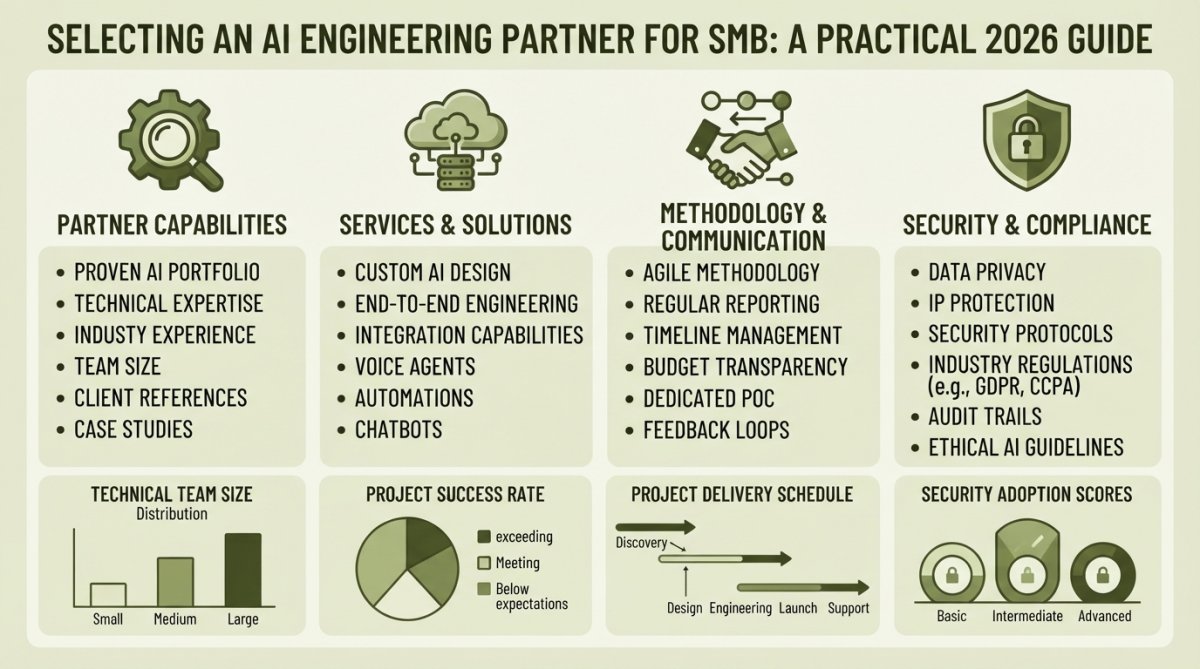
These questions force clarity. During scoping, insist on a written statement of work that includes: the specific problem being solved, measurable success criteria, timeline, cost breakdown, and post-launch support terms. If a partner resists writing these details, that's a red flag.
Also clarify data ownership and intellectual property before signing. Who owns the trained model? If you leave the partner, can you take the system with you? Can they use your data to train models for other clients? Get answers in writing.
Evaluating Vendors: Technical Expertise vs. Support Quality
Technical capability matters, but support quality matters more. You need both.
Evaluate technical expertise by asking about previous projects. Request case studies or references from similar-sized businesses in your industry. Ask specific questions about their experience with your use case. Vague answers suggest they're learning on your dime.
Evaluate support quality by testing their responsiveness during sales. How quickly do they respond to emails? Do they ask clarifying questions or rush to close? After signing, will you have a dedicated point of contact or get routed through a support ticket system? What's their SLA for critical issues?
Ask about post-launch support explicitly. Some partners include 30 days of free support after launch, then transition to hourly billing. Others include quarterly optimization reviews in their retainer. These differences compound over time.
Also evaluate cultural fit. Do they understand your business? Do they ask good questions? Do they push back on unrealistic timelines? Partners who challenge your assumptions are valuable.
Hybrid AI Models: Internal Team + Outsourced Development
The most sustainable approach for growing SMBs combines internal expertise with outsourced development. Consider hiring a single "AI operations" person with 3-5 years of AI experience who can work part-time or full-time. This person's job isn't to build AI systems from scratch, it's to understand your business problems, brief external partners, review their work, and ensure quality.
This hybrid model costs less than hiring a full engineering team ($80K-$120K annually for one operations person plus $3K-$8K monthly for outsourced development) but gives you far more control and continuity than pure outsourcing. Your internal person becomes the institutional knowledge holder and improves partner accountability.
Legal and IP Ownership Frameworks for Outsourced AI
Intellectual property ownership must be defined clearly before any work begins. Standard approaches include:
Full ownership transfer: You pay more upfront but own all code, models, and documentation. If the partnership ends, you own everything. Expect to pay 20-30% more for this model.
Licensing model: You own the business outcomes (the trained model, system performance), but the partner retains ownership of underlying code and frameworks. You pay less upfront but depend on the partner for maintenance.
Hybrid: You own custom code and trained models specific to your business, but the partner retains ownership of their proprietary frameworks and tools.
Data privacy must also be addressed. Confirm that your customer data and proprietary information won't be used to train models for competitors. Most reputable partners will sign data protection agreements confirming this.
Also clarify what happens if the partnership ends. Can you export your data? Can you access the system? Will the partner provide documentation so another team can maintain it?
Common Pitfalls When Outsourcing AI Engineering for SMB
Vague project scope is the leading cause of failed engagements. Before signing, write down the specific business outcome you're targeting. "Reduce phone answering time by 40%" beats "implement AI."
Underestimating data preparation derails many projects. AI systems require clean, well-organized training data. If your data is scattered across five systems, poorly labeled, or incomplete, the partner will spend weeks preparing it. Before engaging a partner, audit your data and budget extra time for preparation.
Neglecting post-launch maintenance causes gradual degradation. Build maintenance into your plan from the start.
Choosing partners based on price alone creates quality problems. The cheapest partner often cuts corners. Evaluate partners on value, not cost.
Failing to define success metrics means you can't measure whether the AI worked. Before launch, agree on specific metrics: "The system will answer 60% of inbound calls without human transfer." "Response time will drop from 48 hours to 4 hours."
Assuming the partner understands your business creates misalignment. Invest time explaining your business, share customer feedback, and help them understand why this matters to you.
Outsourcing AI engineering for SMB works when you have a specific problem, a clear budget, and realistic expectations about timelines and ongoing costs. For most SMBs, outsourcing is faster, cheaper, and lower-risk than hiring an internal team.
Uberwood Agency specializes in designing, engineering, and operating custom AI systems that solve specific business problems without requiring you to build internal expertise. Whether you need voice automation to handle customer calls, workflow automation to eliminate data entry, or predictive analytics to improve decision-making, we manage the technical complexity so you can focus on growing your business. Get a free estimate quote and book a call today to discuss your specific AI needs and explore whether outsourcing makes sense for your situation.
Frequently Asked Questions
What are the main benefits of AI outsourcing for small business?
Outsourcing AI engineering lets you access specialized technical expertise without hiring full-time engineers, reducing payroll and overhead. You gain faster time-to-market for custom AI solutions, avoid technical debt from in-house experimentation, and scale automation without managing infrastructure. Your team can focus on core business outcomes, like closing deals or serving customers, while your outsourcing partner handles the heavy lifting of generative AI development, prompt engineering, and system integration.
How do I know if outsourcing AI is worth the cost compared to hiring in-house?
The cost of outsourced AI development for SMB depends on project scope, not headcount. In-house hiring locks you into fixed salary, benefits, and training costs even during slow periods. Outsourcing lets you pay for what you build, ideal if you're testing an MVP or need managed services without long-term commitment. Compare total cost of ownership: salary + benefits + tools + overhead vs. outsourcing fees + post-implementation maintenance. Most SMBs find outsourcing cheaper for specialized, time-bound projects.
What AI solutions can small businesses realistically outsource?
SMBs commonly outsource voice agents for customer service, chatbots for lead qualification, workflow automation for internal processes, predictive analytics for forecasting, and API development for SaaS integration. The best candidates are repeatable, high-volume tasks, like call routing in home services, order processing in e-commerce, or appointment scheduling. Your outsourcing partner should help you identify which business outcomes deliver the most ROI, then build custom AI solutions tailored to your specific workflows and compliance requirements.
How do I protect my intellectual property when outsourcing AI engineering?
Establish clear legal and IP ownership frameworks before signing any contract. Your agreement should explicitly state that you own all custom code, trained models, and proprietary data. Use non-disclosure agreements (NDAs), limit vendor access to sensitive business data, and require data security compliance with relevant standards. Prefer vendors who offer managed services under one roof, like fully managed AI systems, because they're incentivized to protect your IP and maintain long-term relationships. Always clarify post-implementation maintenance responsibilities and support escalation procedures.
This article was written using GrandRanker