Table of Contents
- Why Roofing Contractors Are Turning to AI in 2026
- AI Construction Project Management Software: What It Actually Does
- AI Chatbots for Roofing Lead Qualification
- Automated Roofing Estimation Tools and Aerial Measurement
- Predictive Scheduling and Real-Time Project Visibility
- What AI Can't Do: Risks, Ethics, and Human-in-the-Loop Workflows
- Calculating ROI for Small and Mid-Sized Roofing Firms
- Frequently Asked Questions
Last Updated: September 28, 2026
Why Roofing Contractors Are Turning to AI in 2026
Roofing contractors are turning to AI because the administrative load of running a roofing business has outgrown the crews doing the work. Uberwood Agency works with home service businesses every week, and the pattern is consistent: owners spend their evenings quoting jobs, chasing leads, and reconciling material orders instead of selling. The U.S. Bureau of Labor Statistics occupational outlook for construction managers confirms that demand for skilled construction management labor keeps rising while the supply of experienced estimators stays tight.
That gap is the real story. Roofing project management has always been a coordination problem, and coordination is what modern AI systems handle well. Below, we break down what the software does, where it fails, and how to calculate whether it pays for itself.
AI Construction Project Management Software: What It Actually Does
AI construction project management software applies machine learning, document analysis, and natural language processing to the scheduling, estimating, and communication tasks that traditionally consumed a project manager's day. It does not replace the project manager, it removes the repetitive work around them.
Core Capabilities That Matter for Roofing Crews
For roofing, the capabilities that move the needle are narrower than vendors admit. Here is what actually gets used on a jobsite:
- Automated scheduling and resource allocation that reassigns crews when weather delays a tear-off
- Document analysis for submittals, permits, and manufacturer warranty paperwork
- Voice-to-text field reporting so a foreman can log progress without leaving the roof
- Job summaries generated automatically from photos, notes, and time entries
- Expense tracking tied to material procurement and change orders
How It Fits With Your Existing Tools
This is where most implementations stall. A roofing company running a legacy CRM, a separate estimating spreadsheet, and a QuickBooks file does not need a fourth disconnected system. The requirement is integration with what you already run, or a platform that replaces two of those tools rather than adding one.
Step 1: Audit your data sources before you buy anything. List every place a job record lives, the CRM, the estimating spreadsheet, the accounting file, the shared inbox, the text thread with the homeowner. Most roofing companies find the same job in four or five places with slightly different details. Any AI tool you add inherits that inconsistency unless you decide which system is the source of truth first.
Step 2: Identify the API surface of each tool. Modern CRMs and accounting platforms expose APIs that let a new system read and write records in near real time.
What Integration Actually Costs You in Time
Contractors who do this successfully typically need a two-to-six week onboarding window before the system runs cleanly. The work is not the software setup, it is the data cleanup, the decision about which system owns which field, and retraining office staff. Budget for that time explicitly, because contractors who treat integration as a weekend project abandon the tool.
Human-in-the-Loop Is the Default, Not the Exception
Every capability above should ship with a human approval gate on anything touching price, schedule commitments, or customer-facing promises. AI drafts the schedule; a human confirms the crew assignment. AI summarizes the job; a human reviews before it goes to the homeowner. This keeps liability where it belongs and experienced people in the loop on risky decisions.
AI Chatbots for Roofing Lead Qualification
An AI chatbot for roofing lead qualification answers inbound inquiries, asks the qualifying questions a good office manager would ask, and routes serious prospects to a human. The value is not the conversation itself. It is the response time.
- It asks about roof type, approximate square footage, and whether an insurance claim is involved
- It hands off to a human the moment the conversation moves toward pricing commitments
- It writes every exchange back to your CRM automatically
| Lead Handling Approach | Response Time | Best For | Main Limitation |
|---|---|---|---|
| Voicemail only | Hours to days | Very low volume | Most callers hang up |
| Answering service | Minutes | Steady call volume | Scripts are rigid |
| AI chatbot plus voice agent | Seconds | Growing contractors | Needs clean CRM integration |
Automated Roofing Estimation Tools and Aerial Measurement
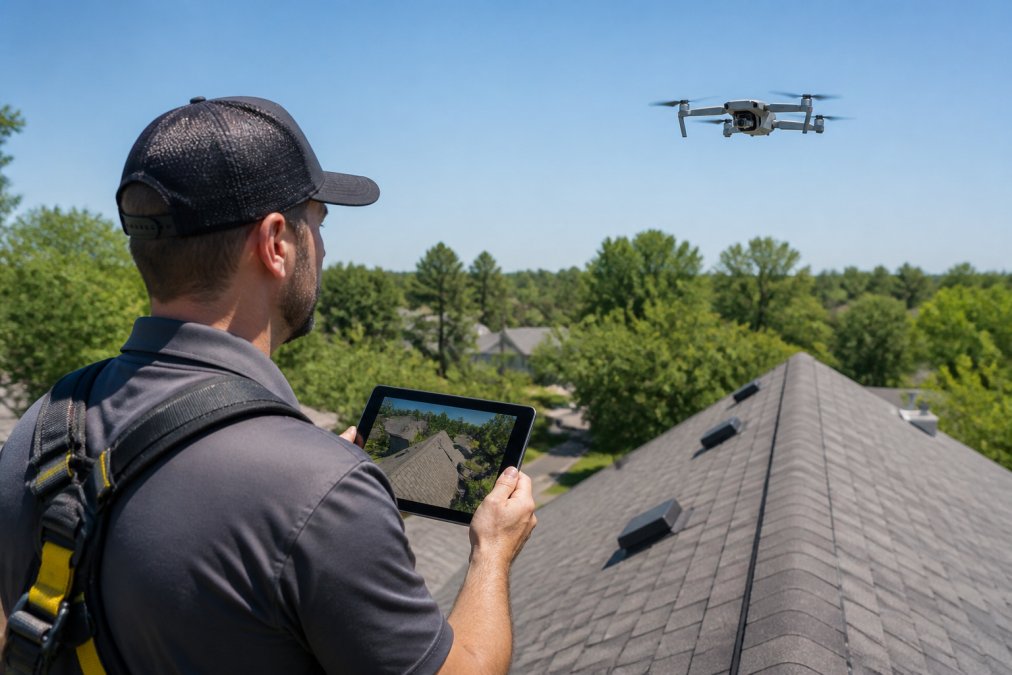
Automated roofing estimation tools combine aerial measurement data with material pricing to produce a quote without a manual roof walk. Aerial measurement pulls roof dimensions from satellite or drone imagery, and the estimation layer applies pitch, waste factor, and current material costs to generate a line-item proposal.
How the Measurement-to-Estimate Workflow Actually Runs
The workflow has four stages, and knowing them helps you spot where a tool saves time versus where it creates rework.
Where Aerial Measurement Is Reliable and Where It Is Not
Contractors using these tools typically trust the measurement on simple roofs and verify it on complex ones. The practical rule: if the roof has more than two or three distinct planes, or any feature the imagery cannot clearly resolve, send someone to the roof before the estimate goes out.
The Human-in-the-Loop Step That Protects Your Margin
The estimate that reaches the customer should always carry a human signature, even when the software generated every number. The estimator is the last line of defense against a measurement error, a stale material price, or a scope item the imagery could not see. Build the review in as a required step and log who approved each estimate, when a job goes sideways, that log tells you whether the problem was the tool or the process.
What This Means for Your First-Pass Quote Speed
The practical gain is speed on the first pass: a contractor can send a ballpark number the same day and reserve the physical inspection for jobs that clear the initial filter. That matters because roofing leads are time-sensitive, the homeowner with an active leak is calling three contractors, and the one who responds with a credible number first usually gets the inspection.
Predictive Scheduling and Real-Time Project Visibility
Predictive scheduling uses historical weather, crew availability, and job duration data to build a schedule that survives contact with reality. Real-time project visibility is the dashboard layer showing every job's actual status against that plan.
What AI Can't Do: Risks, Ethics, and Human-in-the-Loop Workflows
AI cannot make judgment calls about structural damage, insurance disputes, or safety conditions, and any system that pretends otherwise creates liability. Human-in-the-loop workflows keep a qualified person reviewing anything that carries risk.
A workable human-in-the-loop design looks like this:
- AI drafts the estimate; a human approves before it reaches the customer
- AI flags unusual conditions; a human decides whether to inspect
- AI handles routine scheduling; a human handles any change that affects price
- Every automated customer message is logged and reviewable
Calculating ROI for Small and Mid-Sized Roofing Firms
ROI for a small or mid-sized roofing firm comes down to hours recovered and leads captured, both estimable without a finance background.
| ROI Input | How to Estimate It | Why It Matters |
|---|---|---|
| Admin hours per week | Time-tracking for two weeks | Largest recoverable cost |
| Hourly value of that time | Owner or office manager rate | Converts hours to dollars |
| Missed calls per week | Phone logs during peak season | Direct revenue loss |
| Average job value | Trailing 12-month average | Sizes the opportunity |
| Close rate on recovered leads | Your historical close rate | Realistic capture estimate |
Frequently Asked Questions
How can AI improve efficiency in roofing project management?
AI reduces the manual work that eats into a roofing contractor's day. Automated scheduling tools assign crews based on weather, location, and skill set. Aerial measurement software turns a drone flight into accurate material counts in minutes. Chatbots qualify leads before they reach your phone. The cumulative effect is fewer hours spent on administrative tasks and more hours available for actual roofing work, which directly improves operational throughput.
What are the best AI tools for roofing contractors in 2026?
The right tool depends on where your bottlenecks are. For lead response, AI chatbots and voice agents handle initial qualification. For measurement, aerial imaging platforms generate roof reports without a site visit. For project tracking, AI construction project management software connects scheduling, submittals, and field reporting in one place. Many contractors get the best results from a fully managed system that integrates all three rather than piecing together standalone apps.
Can AI help with roofing material estimation and waste reduction?
Yes. Automated roofing estimation tools use aerial imagery and machine learning to calculate roof area, pitch, and complex features like valleys and dormers. That data feeds directly into material orders, so you buy closer to what the job actually needs. Contractors who adopt these tools report less leftover material and fewer emergency supply runs, though exact savings depend on roof complexity and how accurately the initial measurement is captured.
What are the risks of implementing AI in construction project management?
The main risks are integration failure with legacy roofing software, data privacy concerns when customer information flows through third-party systems, and AI errors that go unchecked. A chatbot that misroutes an urgent repair call or an estimation tool that misreads a complex roof can cost you a job or a customer. Human-in-the-loop workflows, where a person reviews AI output before it reaches the customer, reduce these risks significantly.