Table of Contents
- What Are AI Voice Agents for Plumbing Businesses?
- Key Benefits: Why Plumbing Companies Need AI Voice Agents
- AI Customer Service for Plumbers: Handling Your Call Volume
- AI Tools for Plumbing Scheduling: Appointment Automation
- Implementing AI in Plumbing Operations: Technical Setup & Security
- Cost of AI Voice Agents for Small Businesses: ROI Reality Check
- Common Implementation Pitfalls and How to Avoid Them
- Choosing the Right AI Voice Agent for Your Plumbing Team
AI Voice Agents for Plumbing: Setup, Security & ROI
Last Updated: July 22, 2026
What Are AI Voice Agents for Plumbing Businesses?
AI voice agents for plumbing businesses are intelligent phone systems that answer calls, qualify leads, and schedule appointments automatically, 24/7, without human staff. They use natural language processing to understand caller intent, extract key information, and route requests to the right department or technician. The caller experiences a natural conversation; the plumbing business gets structured data automatically fed into their CRM and dispatch system.
How They Differ From Traditional Answering Services
Traditional answering services employ staff who take notes and relay messages, creating inconsistent quality, lost information, and high turnover costs. AI voice agents eliminate these friction points:
- Availability: AI agents work every hour; traditional services have business hours and holiday closures.
- Consistency: AI agents perform identically on every call; human staff get tired and make mistakes.
- Data capture: AI agents extract structured data (name, address, problem type, urgency) automatically; people create messy records.
- Integration: AI agents push data directly into your CRM and field service software in real time.
- Cost scaling: AI agents cost the same whether you handle 10 or 100 calls per day.
The most important difference is what happens after the call. Traditional services end the conversation. AI voice agents continue it, sending follow-ups, confirming appointments, and collecting feedback without human involvement.
Key Benefits: Why Plumbing Companies Need AI Voice Agents
AI voice agents solve a specific problem: plumbing businesses lose money on every call they miss. A missed call is a missed job. The benefits compound across revenue, efficiency, and customer experience.
24/7 Emergency Call Handling Without Staffing Costs
Plumbing emergencies don't wait for business hours. A burst pipe at 2 AM is a job. Most plumbing companies either staff overnight (expensive) or lose calls (costly). An AI voice agent answers every call, every time.
Hiring one full-time overnight answering person costs roughly $30,000-$40,000 annually. An AI voice agent handling the same volume costs a fraction of that and never calls in sick or takes vacation. Emergency calls also carry premium pricing, if you answer those calls, you capture that revenue.
Lead Qualification and Automated Intake in Real Time
Not every call is a job. Some callers want price quotes; some are calling the wrong number. An AI voice agent qualifies the call before your team touches it.
Qualification happens through natural conversation. The agent asks what's wrong, where it is, how urgent it is, and what they've already tried. Within 30 seconds, the system knows whether this is a $200 job or a $2,000 job. This data flows directly into your CRM and dispatch software. Your technician arrives with full context, no surprises, no wasted time gathering information.
AI Customer Service for Plumbers: Handling Your Call Volume
Call volume is the constraint that kills plumbing businesses. An AI voice agent removes this bottleneck by handling unlimited call volume instantly.
Routing, Dispatch, and Service Request Classification
An AI voice agent understands that not all calls go the same direction. It asks the right questions, classifies the request, and sends it to the right system:
- Emergency dispatch: For burst pipes or gas leaks, the system immediately alerts an on-call technician and creates a high-priority job.
- Scheduled appointment: For routine work, it offers available time slots and books directly into your field service software.
- Commercial account handler: For contract customers, it routes to the account manager.
- Callback queue: If all technicians are booked, it schedules a callback at a specific time.
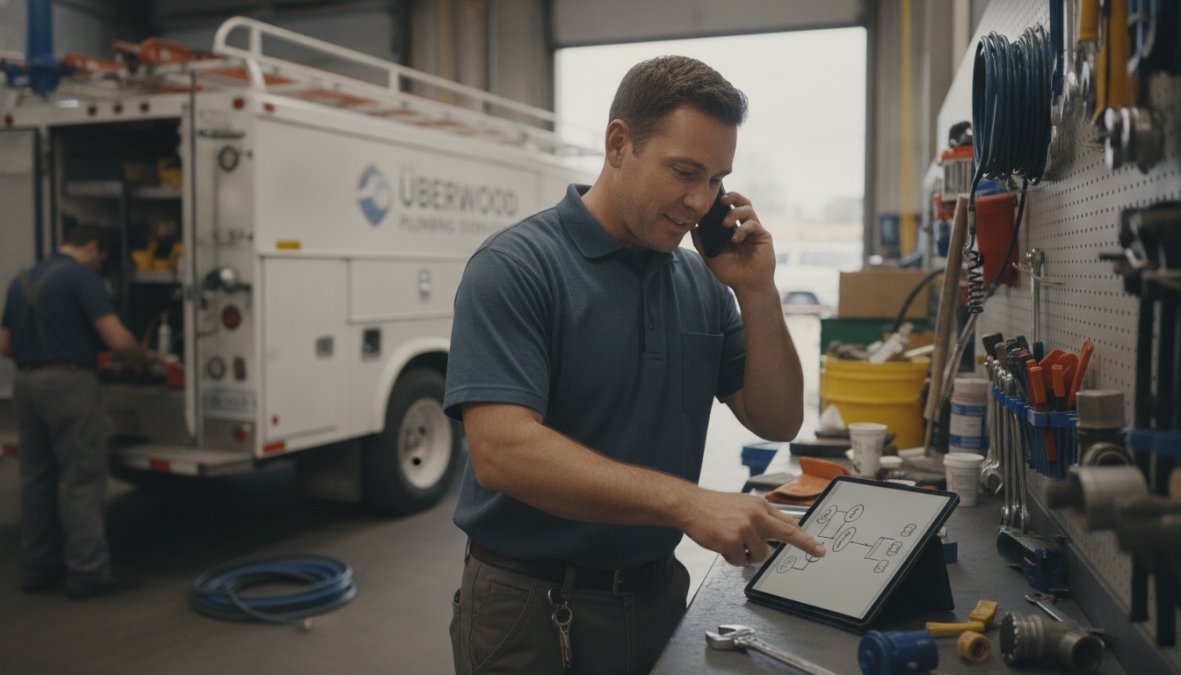
Service request classification is where the AI proves its value. It understands context, a customer saying "my sink is draining slow" is different from "my sink backed up into my basement." One is routine maintenance; one is an emergency. The AI knows the difference and routes accordingly.
AI Tools for Plumbing Scheduling: Appointment Automation
Scheduling is where most plumbing companies leak time. A customer calls, staff checks the calendar, offers times, customer says "I'll call you back," and the job never gets scheduled.
An AI voice agent schedules the appointment during the first call. The caller says "I need someone Tuesday between 9 and 5." The system checks availability and confirms. Appointment is booked. Confirmation text is sent. This single change increases show-up rates by 15-25% and eliminates callback queues.
CRM and Field Service Software Integration
The AI voice agent integrates with your CRM, field service software, accounting, and dispatch. When a customer books an appointment, the system creates a job in your field service software, assigns it to the next available technician based on location and skill, and sends the technician full job details.
This integration is critical. A system that answers calls but doesn't integrate with your operations creates more work, not less. Integration also enables smarter dispatch, your field service software can route based on proximity, skills, and availability, cutting travel time and increasing jobs per technician per day.
Implementing AI in Plumbing Operations: Technical Setup & Security
A beautiful AI voice agent that breaks down on day one creates chaos. Implementation must be fast, reliable, and secure.
API Security, Latency, and Data Protection
The AI voice agent sits between your phone system and backend systems. This data flow must be secure and fast.
Latency matters. If there's a 2-3 second delay between when the caller speaks and when the AI responds, the conversation feels broken. The industry standard is sub-800ms latency.
Security is non-negotiable. The system handles customer phone numbers, addresses, payment information, and problem descriptions. Look for vendors with:
- API authentication: OAuth 2.0 or similar modern authentication
- Encryption: TLS 1.2 or higher for data in transit; AES-256 for data at rest
- Audit logging: Every API call, data access, and configuration change logged with timestamps
- Data retention policies: You control how long call recordings and transcripts are stored
- Compliance certifications: SOC 2 Type II is baseline; HIPAA compliance if handling health-related data
Review the vendor's security posture before signing. A breach discovered after launch is catastrophic.
Voice Tone and Brand Customization
An AI voice agent that sounds like a robot loses calls. Modern systems offer significant customization, you can choose voice, gender, accent, and age range. You can customize greetings, questions, and response tone to reflect your brand's personality.
The system should ask questions specific to your business. A plumbing company needs location, problem type, and urgency. The system should reflect your specific workflows, not generic plumbing knowledge.
Cost of AI Voice Agents for Small Businesses: ROI Reality Check
The ROI calculation is straightforward. An AI voice agent costs money but also saves money and generates revenue.
Comparing Automation vs. Hiring Additional Staff
A 15-person plumbing company getting 40 calls per day during peak season has two office staff spending 4 hours per day on intake.
Option A: Hire a third office staff member. Cost: $35,000-$45,000 per year.
Option B: Implement an AI voice agent. Cost: typically $500-$2,000 per month.
Automation costs less. But the real ROI comes from missed call recovery. If you recover just 5 additional jobs per week at $400 average value, that's $2,000 per week in additional revenue. Over a 12-week peak season, that's $24,000. The AI voice agent pays for itself.
Your existing staff also spends less time on intake and more time on higher-value work. Technicians arrive with complete information and close jobs faster, completing more jobs per day.
Conservative estimate: an AI voice agent generates 2-3x its cost in additional revenue and efficiency gains within the first year.
Common Implementation Pitfalls and How to Avoid Them
Implementation failures fall into three categories: technical, operational, and behavioral.
Hallucination Risks, Hybrid Models, and Fallback Protocols
Hallucination occurs when an AI system makes up information. A caller asks "Do you service commercial properties?" The AI confidently says "Yes," but your company doesn't. The customer books a job. You cancel it. You lose the customer.
Prevention requires a hybrid model where the AI handles what it's good at (answering calls, qualifying urgency, capturing information) and defers to humans or a knowledge base for questions about your specific services.
A strong hybrid model:
- AI handles: Call routing, emergency triage, appointment scheduling, basic troubleshooting
- Human handles: Complex questions about your services, pricing exceptions, commercial accounts, complaints
- Knowledge base handles: FAQs, service area confirmation, standard pricing, warranty information
If the AI encounters a question outside its training, it should say "Let me connect you with someone who can answer that" and route to a human.
Fallback protocols are critical. What happens if the AI system goes down? You need a tiered fallback:
- Tier 1: AI system answers and processes normally
- Tier 2: If AI is down, calls route to a live answering service
- Tier 3: If both are down, calls route to a team member's cell phone
Test the system with real calls before going live. Have team members call in with various scenarios. Does it handle emergencies correctly? Does it schedule accurately? Does it route properly? Fix issues in testing, not after launch.
Choosing the Right AI Voice Agent for Your Plumbing Team
Not all AI voice agents are created equal. Some are generic systems adapted for plumbing; some are purpose-built for home services.
Evaluation Criteria and Vendor Comparison
When evaluating vendors, score them across these dimensions:
| Criteria | What to Evaluate | Why It Matters |
|---|---|---|
| Call Quality | Sub-800ms latency, natural voice, interruption handling | Callers hang up if the system feels slow or robotic |
| Integration | CRM, field service, accounting software compatibility | Data that doesn't integrate wastes staff time |
| Customization | Voice selection, response scripting, workflow configuration | Generic systems don't reflect your brand |
| Security | SOC 2 certification, encryption, audit logging | Customer data breaches destroy trust |
| Support | Response time, escalation path, implementation help | You need help when things break |
| Pricing Model | Per-call, per-month, or hybrid | Some vendors hide costs in per-call fees |
| Fallback Options | What happens if the system fails | Failures happen; you need a backup |
The most critical evaluation is integration. Before choosing a vendor, confirm they integrate with your specific tools and test the integration in a sandbox environment.
The second critical evaluation is support. Responsive, knowledgeable support is worth paying more for.
Pricing varies widely. Some vendors charge per call ($0.50 per call). Some charge per month ($500-$2,000). Some charge hybrid ($500/month + $0.10 per call above 500 calls). For a small plumbing company with 40-100 calls per day, a monthly plan typically costs less.
The implementation process should include:
- Discovery: Map your current call workflows and pain points
- Design: Design the AI system's responses and integrations
- Build: Configure the system and test integrations
- Pilot: Run the system in parallel with your current process for 1-2 weeks
- Launch: Switch to the AI system as your primary answering method
- Optimization: Monitor performance and refine responses based on real calls
This process typically takes 4-8 weeks from start to full launch.
Every call a plumbing company misses is revenue lost to a competitor. An AI voice agent answers every call instantly, qualifies it accurately, and integrates the information directly into your operations. For a small plumbing company, this eliminates the bottleneck that prevents growth. Get A Free Estimate Quote And Book A Call Today to see how an AI voice agent can transform your plumbing business.
Frequently Asked Questions
Can AI voice agents for plumbing handle my call volume without dropping calls?
Yes, modern AI voice agents are built to handle typical plumbing call volumes (15-20+ daily calls during peak season) without dropped calls when properly configured. They use sub-800ms latency telephony infrastructure and intelligent call routing to distribute incoming requests. However, success depends on correct setup: your AI system must be integrated with your field service management software and trained on your specific service areas, emergency protocols, and job types. A fully managed provider handles this configuration so you don't have to babysit the system.
How do AI voice agents integrate with my existing CRM and scheduling software?
AI voice agents integrate via API connections to your CRM and field service management platform. During customer intake, the agent captures service requests, customer details, and job classification data, then automatically logs this into your system in real time. This eliminates manual data entry and ensures technicians are prepared before arrival. Integration quality varies by vendor, look for providers offering native connectors to platforms like HubSpot, ServiceTitan, or similar tools, or those willing to build custom API bridges. Uberwood Agency specializes in seamless end-to-end integrations under one roof, so you avoid disconnected systems.
What's the actual ROI of AI voice agents compared to hiring another person to answer phones?
ROI depends on your call volume, labor costs, and missed-call recovery rate. An AI voice agent typically costs less than a full-time employee (salary + benefits + training), operates 24/7 without breaks, and never misses calls. The real value emerges from lead qualification and automated follow-ups, AI agents capture and qualify leads while your team focuses on closing deals. For small plumbing businesses, cost of AI voice agents for small businesses is usually offset within 3-6 months through recovered missed calls and reduced administrative overhead. Pricing depends on your specific setup, so request a free estimate to compare your situation.
What happens if the AI misroutes a call or gives a customer incorrect information?
Implementation failure risks exist, but managed providers mitigate them through hybrid models: the AI handles routine calls and qualification, but escalates complex or urgent issues to a human immediately. This prevents hallucination problems. Additionally, proper voice tone customization and prompt engineering, training the agent on your specific service protocols, emergency triage procedures, and brand voice, reduces errors significantly. Choose a provider offering 24/7 support monitoring; if something breaks at 2 AM, they handle it without you needing to intervene. Uberwood Agency's fully managed approach includes ongoing optimization to catch and fix issues before they impact customers.
This article was written using GrandRanker