Table of Contents
- AI Voice Agents vs Human Receptionists: Core Differences
- Feature Comparison Table: AI Voice Agents vs Human Receptionists
- Benefits of AI Voice Agents for Your Business
- Limitations of AI Receptionists: What You Need to Know
- AI Receptionist Cost vs Human Receptionist Pricing
- The Hybrid Receptionist Model: Best of Both Worlds
- Which Solution Wins for Your Business?
- Conclusion: Making the Right Call
AI Voice Agents vs Human Receptionists: A 2026 Comparison
Last Updated: July 21, 2026
When choosing between AI voice agents and human receptionists, businesses face an increasingly complex decision as both have matured significantly. This isn't a simple binary choice, it's about understanding where each solution excels. Below, we examine the core differences, cost implications, and real-world trade-offs to help you decide.
AI Voice Agents vs Human Receptionists: Core Differences
What AI Voice Agents Do
AI voice agents are software systems powered by natural language processing and voice synthesis. They answer calls automatically, understand customer requests through speech-to-text conversion, and respond with pre-programmed or AI-generated answers. They route calls to departments, qualify leads, book appointments, capture information, and escalate to humans when necessary.
Modern AI agents differ from older IVR systems by having more natural conversations. They don't require button-pressing; they listen, understand context, and adapt responses. They work 24/7, handle multiple calls simultaneously, and maintain perfect consistency.
However, they struggle with complex emotional situations, nuanced judgment calls, and unexpected scenarios. They can't read tone of voice or always handle accents and background noise. Most importantly, they can't build relationships or show genuine empathy.
What Human Receptionists Do
Human receptionists greet callers warmly, listen to needs, ask clarifying questions, and make real-time decisions. They handle complaints, show empathy, adapt to unusual situations, and represent your business with personality and judgment.
A skilled receptionist becomes familiar with regular callers, remembers details, and makes exceptions when appropriate. They handle complex multi-step requests and build rapport that converts inquiries into loyal customers.
The trade-off is cost, availability, and consistency. Hiring receptionists means payroll, benefits, training, and scheduling challenges. They get tired, take vacations, and deliver inconsistent service. They handle one call at a time, so peak hours mean calls go to voicemail.
Feature Comparison Table: AI Voice Agents vs Human Receptionists
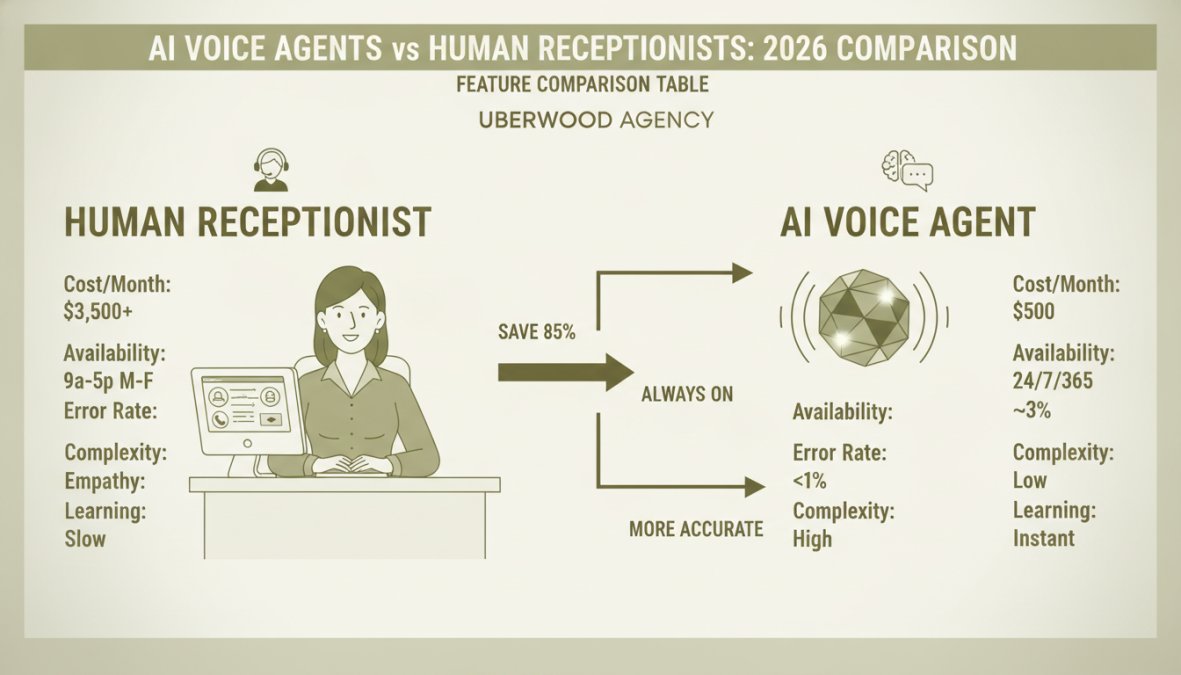
| Feature | AI Voice Agents | Human Receptionists | Winner |
|---|---|---|---|
| 24/7 Availability | Always on, no breaks | Requires scheduling/coverage | AI |
| Cost Per Call | $0.50-$2.00 | $5-$15 (labor-based) | AI |
| Scalability | Handles unlimited simultaneous calls | Limited by staff count | AI |
| Empathy & Emotional Intelligence | Limited; follows scripts | Natural, adaptive | Human |
| Complex Problem-Solving | Struggles with edge cases | Excels at nuanced situations | Human |
| Setup Time | 1-4 weeks | 2-6 weeks (hiring + training) | Tie |
| Consistency | Perfect; no variation | Varies by person & mood | AI |
| Integration with CRM/Tools | API-native; seamless | Manual entry; time-consuming | AI |
| Handling Upset Customers | May escalate unnecessarily | De-escalates naturally | Human |
| Lead Qualification | Rule-based; reliable for routine | Judgment-based; nuanced | Human |
Benefits of AI Voice Agents for Your Business
24/7 Availability and Scalability
AI voice agents answer calls at 3 AM on weekends without overtime costs. During peak season, they handle 10x normal call volume without hiring additional staff. For home services companies like plumbing or HVAC, an AI agent can qualify emergencies, capture job details, and book appointments directly into the calendar while escalating true emergencies to human dispatchers immediately.
One receptionist handles roughly 30-50 calls daily. An AI agent handles 200+ simultaneously. As your business grows, human receptionists become a bottleneck.
Cost Efficiency and Predictable Budgeting
A full-time receptionist costs $28,000-$40,000 annually in salary alone, plus payroll taxes, benefits, and training. AI voice agents operate on subscription models with transparent, predictable pricing that doesn't increase with call volume.
AI costs scale with actual usage. A slow month costs less; a surge doesn't increase per-call rates. With humans, you either have idle staff or you're understaffed. Additionally, AI eliminates HR overhead: no scheduling, absences, or employment regulations to manage.
Consistency and Rapid Integration
Every call is handled identically. Your AI agent doesn't have bad days, misunderstand instructions, or represent your brand inconsistently. This matters for compliance-heavy industries where every interaction must be documented and standardized.
Integration with CRM, scheduling software, and payment systems happens automatically. When a customer books an appointment, it goes directly into your calendar. When they provide their phone number, it's captured and added to your database without manual data entry.
Limitations of AI Receptionists: What You Need to Know
Handling Complex and Emotional Interactions
An AI agent can't comfort an angry customer or make judgment calls about policy exceptions. It can't hear frustration in someone's voice and respond with genuine empathy that de-escalates tension.
A customer calling about a billing error receives: "I can transfer you to billing. Please hold." A human says: "I understand that's frustrating. Let me look into this for you right now." For service-based businesses where customer relationships drive retention, this is a real problem.
Implementation Failure Rates and Ongoing Support
Many businesses encounter problems after implementation: the system misunderstands accents, fails to recognize regional terminology, or gets confused by background noise. Fixing these issues requires technical knowledge and vendor support, adding cost and delays.
Implementation typically takes 4-8 weeks for complex businesses. You must map every possible call scenario, define responses, test extensively, and iterate based on real-world results.
Data Security and Compliance Risks
Every call is recorded and stored. In healthcare, finance, or regulated industries, you need compliance certifications like HIPAA, GDPR, or PCI-DSS. Many AI platforms don't offer these guarantees.
Data lives on vendor servers, trusting a third party with customer information and call recordings. If the vendor has a security breach or goes out of business, your data is at risk. For businesses handling sensitive information, this is a dealbreaker.
AI Receptionist Cost vs Human Receptionist Pricing
Total Cost of Ownership Analysis
A full-time human receptionist costs approximately $28,000-$40,000 annually in salary, plus payroll taxes ($2,500-$3,500), benefits ($4,000-$8,000), training ($500-$2,000), workspace ($1,000-$2,000), and turnover costs ($2,000-$5,000 amortized).
Total annual cost for one full-time receptionist: $38,000-$60,000
An AI voice agent platform costs $1,500-$5,000 annually for small businesses with moderate call volume. At scale, if you need two receptionists ($76,000-$120,000), an AI system still costs $5,000-$15,000 because it doesn't scale linearly with labor.
The break-even point is typically around 50-60 calls per day. Below that, a part-time human is cheaper. Above that, AI becomes more cost-effective.
Hidden Costs and Budget Surprises
Integration with your CRM, scheduling software, or payment systems can add $1,000-$5,000 initially. Training the system requires 10-20 hours of staff time. Per-call overages can double monthly bills during spikes. Budget $500-$2,000 annually for vendor support and account for upgrade costs.
Human receptionists have hidden costs too: turnover is the biggest. Replacing a receptionist costs $2,000-$5,000 in recruiting, hiring, and training. With 30% annual turnover (industry average), you're replacing someone every 3-4 years.
The Hybrid Receptionist Model: Best of Both Worlds
When to Use AI for Routine Calls
Deploy AI for predictable calls: appointment scheduling, basic inquiries, lead qualification, after-hours voicemail capture, and routine information requests. For a dental practice, the AI agent asks: "Are you calling to schedule, cancel, or reach the office?" and books appointments directly or captures information for routing.
When to Escalate to Human Agents
Escalate immediately when the AI detects complexity: upset customers, requests outside standard parameters, situations requiring judgment, or when AI confidence drops below a threshold. The AI handles 70-80% of calls efficiently; the 20-30% needing human judgment get routed to someone who can actually help.
Integration and CRM Workflow
The hybrid model only works with seamless AI integration into your CRM and scheduling tools. When customers provide information, it automatically populates your database. When appointments are booked, they sync to your calendar in real-time. This integration eliminates manual data entry, the biggest friction point in traditional workflows.
Which Solution Wins for Your Business?
Choose AI Voice Agents If...
You have high call volume (50+ calls daily) with predictable call types and tight budgets. You need 24/7 coverage without paying for overnight staff. You're in a growth phase where hiring is a bottleneck. You operate in a regulated industry requiring perfect consistency.
Choose Human Receptionists If...
Your calls are complex and emotionally charged. You're in a relationship-based business where receptionist interaction influences customer loyalty. Your call volume is low (under 30 calls daily). You need someone to handle non-call tasks: scheduling meetings, managing calendars, organizing files.
Choose a Hybrid Approach If...
You have moderate to high call volume with mixed complexity. You want to reduce hiring pressure without eliminating human touch. You need 24/7 availability but can't afford full staffing. You want to future-proof your operation as your business grows.
Conclusion: Making the Right Call
The decision between AI voice agents and human receptionists isn't about which is "better", it's about which solves your specific problem most efficiently. AI excels at volume, consistency, and cost. Humans excel at judgment, empathy, and relationship-building.
For most growing businesses, the hybrid approach delivers the best results: AI handles routine calls efficiently, humans handle complex interactions requiring judgment. This reduces hiring pressure, improves customer experience, and scales as your business grows.
The biggest mistake businesses make is implementing AI without proper integration or ongoing optimization. A poorly configured AI agent frustrates customers and damages your brand. If you're ready to explore how a custom AI voice agent could work for your business, Get A Free Estimate Quote And Book A Call Today to discuss your specific needs and see the potential impact on your operations.
Frequently Asked Questions
Can AI voice agents really replace human receptionists for all call types?
AI voice agents excel at handling routine inquiries, appointment scheduling, call routing, basic questions, and provide 24/7 availability. However, they struggle with complex emotional situations, nuanced judgment calls, and high-touch interactions that require empathy. Most businesses find a hybrid receptionist model works best: AI handles routine calls, humans handle escalations. A fully managed solution like Uberwood Agency can orchestrate both seamlessly without requiring your team to manage the complexity.
What's the real difference between AI receptionist cost and hiring a human receptionist?
AI voice agents typically offer lower per-call costs and predictable monthly pricing, while human receptionists charge per-minute or per-call with potential overages. However, total cost of ownership matters. AI requires setup, integration, and ongoing management, though a fully managed service eliminates this burden. Human receptionists provide consistent empathy but limited scalability during peak hours. For small businesses with 15-20 daily calls, AI can be significantly cheaper; for high-volume or high-touch industries, humans may provide better ROI despite higher upfront costs.
What are the main limitations of AI receptionists I should know about?
Key limitations include: difficulty handling emotionally complex situations, occasional misrouting or misunderstanding of specialized terminology, implementation failure rates if not properly integrated with your CRM, and data security concerns around HIPAA/GDPR compliance. AI also lacks true emotional intelligence and nuanced judgment. The biggest risk is deployment without proper support, if something breaks at 2 AM, an unmanaged AI system leaves you exposed. Choosing a fully managed provider eliminates many of these risks through 24/7 monitoring and immediate support.
How does a hybrid receptionist model work, and is it worth the complexity?
A hybrid model uses AI to handle routine calls (scheduling, basic inquiries, call routing) and escalates complex or emotional interactions to human agents. This maximizes cost efficiency while maintaining service quality. Most modern platforms support this through intelligent routing rules and human-in-the-loop workflows. The complexity concern is valid, but fully managed solutions like Uberwood Agency handle orchestration behind the scenes, so your team doesn't have to babysit the system. For home services and e-commerce, hybrids typically deliver the best ROI: lower costs than pure human, better customer experience than pure AI.
What should I look for in an AI receptionist provider to avoid implementation failure?
Prioritize providers offering fully managed, end-to-end solutions with proven CRM integration (HubSpot, Salesforce, etc.), 24/7 support, and transparent data security practices. Ask for case studies from businesses similar to yours, especially home services companies if that's your industry. Verify they handle compliance requirements (HIPAA/GDPR if relevant). Avoid solutions requiring your team to manage the AI directly; that's where most failures happen. Request a free consultation to test integration with your existing systems before committing. Uberwood Agency specializes in custom AI builds with full management, eliminating the risk of deployment failure.
This article was written using GrandRanker