Table of Contents
- The Real Cost of Manual Roofing Operations
- How Roofing Business Automation Tools Cut Administrative Overhead
- Automating Roofing Lead Management From Inquiry to Job Dispatch
- Roofing Estimating Software Benefits and Accuracy Gains
- Field-to-Office Integration: Real-Time Data and Decision Making
- Invoicing Automation and Cash Flow Predictability
- Managing Change and Employee Adoption
- Measuring ROI: What Automation Actually Saves
- Frequently Asked Questions
Last Updated: October 2, 2026
The Real Cost of Manual Roofing Operations
Manual roofing workflows drain money in ways that aren't always obvious. Your crew spends hours answering phones instead of closing jobs. Office staff enter the same information twice across different systems.
The real problem isn't that manual processes are slow. It's that they're expensive. A single missed lead during peak season costs you thousands in revenue.
Reducing roofing operational costs with automation isn't about buying software and hoping for the best. It's about identifying where your business bleeds money and plugging those leaks systematically.
At Uberwood Agency, we specialize in designing, engineering, and operating custom AI systems that streamline your business operations from start to finish.
How Roofing Business Automation Tools Cut Administrative Overhead
Every hour your office staff spends on manual data entry is an hour they're not nurturing leads or managing crews. Roofing business automation tools handle the repetitive work that kills productivity.
Consider what happens without automation. A homeowner calls. Someone answers, takes notes, schedules a site visit, enters the information into your system, sends a confirmation email, and updates your calendar. That's five separate actions. With automation, the call triggers a workflow that does all of it without human intervention.
The biggest wins come from eliminating redundant entry:
- Lead capture automation pulls information from web forms, phone calls, and emails into a single system
- Workflow automation routes leads to the right estimator based on service area and availability
- Scheduling automation sends confirmations and reminders, reducing no-shows
- Document automation generates proposals and contracts from templates
Most roofing companies waste hours per week on tasks that could be automated. Multiply that by your hourly burden rate, and the cost becomes impossible to ignore.
The transition isn't painless. Your team will resist change. That's normal. But the companies that push through the first month of adjustment see measurable relief by month two.
Automating Roofing Lead Management From Inquiry to Job Dispatch
Lead management is where most roofing businesses leave money on the table. A lead comes in. It sits in someone's inbox. Three days later, it gets a response. By then, the homeowner has already called three other roofers.
Automating roofing lead management from inquiry to job dispatch compresses that timeline from days to minutes.
Lead Capture and Initial Qualification
The moment a lead arrives, whether through your website, a phone call, or a referral, it should be captured automatically and routed immediately.
A web form submission triggers an automated response confirming receipt and setting expectations. A phone call is recorded and transcribed. A text message is logged. All of it flows into one place: your CRM.
From there, automation can handle initial qualification. Does the job fall within your service area? Is it a roof type you work on? Is the budget realistic?
The result: response times drop from hours to minutes. Leads that would have gone cold get contacted while the homeowner is still thinking about their roof problem.
Routing and Scheduling Efficiency
Once a lead is qualified, it needs to go to the right person at the right time. Manual routing means someone has to check availability, consider drive time, and send a message.
Automation does it in seconds. The system knows which estimators work which areas, their current schedules, and their workload. It assigns the job to the best available person and sends a notification.
Scheduling automation also reduces no-shows. Automated reminders sent 24 hours and 2 hours before an appointment cut missed appointments by 20-30%. That's fewer wasted drive times and more billable hours.
Roofing Estimating Software Benefits and Accuracy Gains
Estimating is where precision matters most. A low estimate loses you money. A high estimate loses you the job. Manual estimating introduces human error at every step.
Roofing estimating software benefits include built-in accuracy checks, consistent methodology, and faster turnaround. An estimator no longer has to manually calculate square footage, account for pitch, or cross-reference material costs. The software does it.
Aerial measurement reports generated from drone footage or satellite imagery eliminate the need to visit every site in person. You get accurate measurements without sending someone to climb a ladder or drive across town. The estimator reviews the data, applies your pricing model, and generates a proposal in minutes instead of hours.
The accuracy gains compound. Consistent estimates mean fewer disputes after the job is complete. Faster turnaround means you submit proposals while competitors are still scheduling site visits. You close more jobs at better margins.
Field-to-Office Integration: Real-Time Data and Decision Making
The gap between what happens on the job site and what the office knows about it is where decisions break down.
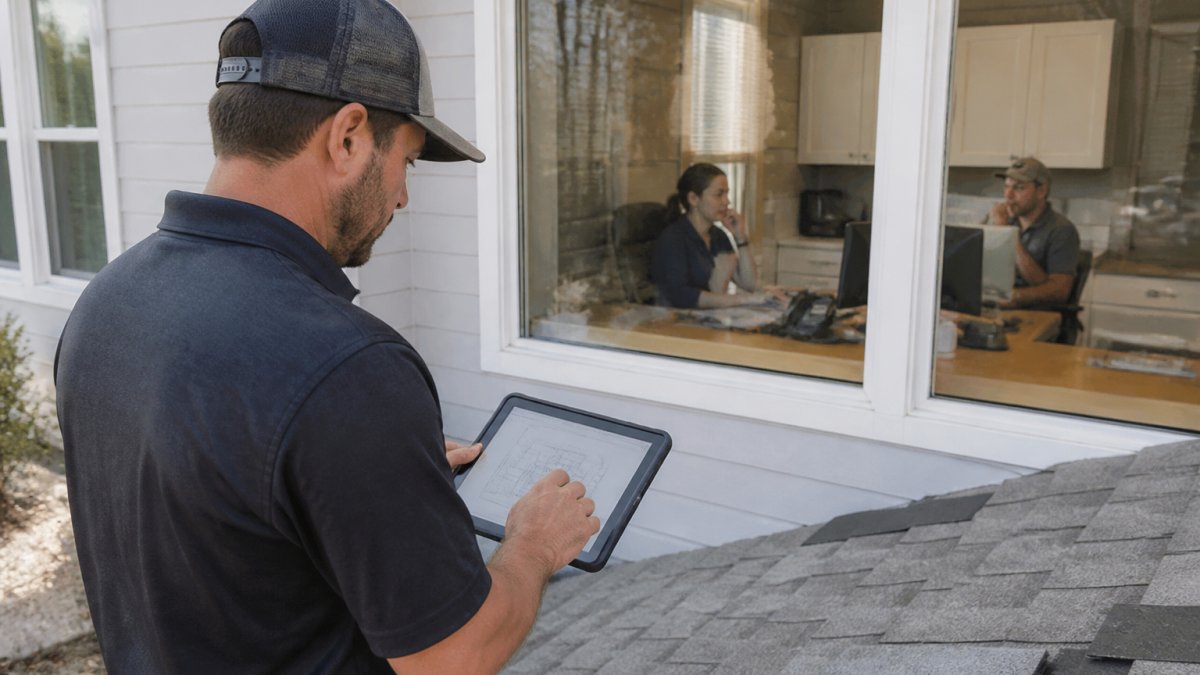
Field-to-office integration closes that gap. Real-time data flows from the site to the office and back.
A crew leader updates job status on a tablet. The office sees it instantly. If the job is ahead of schedule, they can dispatch the crew to the next site.
This integration also improves project management efficiency. You know which jobs are on track, which are behind, and which are over budget before the job is complete.
The data also feeds into business intelligence. Over time, you see patterns: which jobs typically run long, which materials are most frequently needed, which crew combinations work best.
Invoicing Automation and Cash Flow Predictability
Invoicing is the last step in the job cycle, but it's the first step in getting paid. A delayed invoice is a delayed payment. A forgotten invoice is lost revenue.
Invoicing automation generates and sends invoices automatically when a job is marked complete. The homeowner receives it the same day.
Cash flow predictability improves dramatically. You know when money is coming in because you know when invoices are sent.
Automated invoicing also reduces errors. The same information that was used to estimate the job populates the invoice. Quantities, materials, and pricing are consistent.
For growing roofing companies, this is critical. You can't manage cash flow manually when you're invoicing 50+ jobs per month. Automation scales with you.
Managing Change and Employee Adoption
Here's where most automation projects fail: the technology works, but your team doesn't use it.
Your office staff have been doing things a certain way for years. A new system feels like extra work before it feels like less work.
These concerns are real. Addressing them is non-negotiable.
Start by being honest about why you're implementing automation. It's not to eliminate jobs.
Provide training that's specific to your business, not generic software tutorials.
Expect a dip in productivity during the transition. It's normal. Communicate this timeline upfront so people don't panic.
Assign a champion on your team who's excited about the change. They become the go-to person for questions and the internal advocate for the new system.
Measuring ROI: What Automation Actually Saves
Automation sounds good in theory. But you need to know if it actually saves money in your business.
Start by measuring what you're doing now. How many hours does your office staff spend on lead entry per week?
These are your baseline metrics. Track them for two weeks before you implement anything.
After automation is live, measure the same metrics. You should see:
- Response time to leads: drops from hours to minutes
- Estimate turnaround: drops from 2-3 days to same day
- Time to invoice: drops from 5-7 days to 1 day
- No-show rate: drops by 20-30%
- Close rate: improves by 10-20%
Translate those improvements into dollars.
The companies that see the biggest ROI are the ones that don't just implement the tools. They redesign their workflows around what the tools make possible.
Reducing roofing operational costs with automation requires commitment.
If you're managing roofing operations manually, you're competing with one hand tied behind your back. Automation isn't optional anymore. It's the baseline.
The challenge most roofing companies face isn't finding the right tools. It's implementing them without disrupting operations and ensuring your team actually uses them consistently. At Uberwood Agency, we specialize in designing custom AI systems and automations that integrate seamlessly with your existing workflows. Rather than leaving you to figure out implementation, we handle the technical engineering and ongoing management so you can focus on closing deals. Our fully managed approach means your automation keeps working. Get A Free Estimate Quote And Book A Call Today to discuss your roofing automation needs.
| Automation Area | Time Saved Per Week | Cash Flow Impact | Implementation Difficulty |
|---|---|---|---|
| Lead capture & routing | 8-12 hours | Faster response = more closes | Low |
| Estimating | 10-15 hours | Same-day proposals | Medium |
| Field-to-office integration | 6-10 hours | Real-time job visibility | Medium |
| Invoicing | Low |
Frequently Asked Questions
How can automation reduce overhead for roofing companies?
Automation eliminates repetitive administrative tasks like data entry, scheduling, and invoice generation. Instead of office staff manually logging calls and entering job details, your system captures this information automatically. Field-to-office integration means crews don't waste time calling back to confirm details. Fewer manual steps reduce labor hours spent on paperwork, freeing your team to focus on revenue-generating work. Most roofing companies see hours per week recovered in administrative time alone.
What operational tasks in roofing are most easily automated?
Lead capture and routing, estimating from aerial measurements, invoice generation, payment reminders, and scheduling are the fastest wins. Voice agents can handle initial customer inquiries and qualify leads 24/7 without staff involvement. Automated estimating software pulls measurements from photos or satellite data, cutting estimate prep time from hours to minutes. CRM synchronization eliminates manual data re-entry between systems. These tasks require minimal human judgment and see immediate time savings.
How does automated estimating improve roofing profit margins?
Roofing estimating software benefits include faster turnaround (estimates in hours instead of days), fewer pricing errors, and more accurate material takeoffs. When estimates are consistent and based on precise measurements, you win more jobs at the prices you quote. Fewer manual errors mean less margin erosion from underpriced jobs. Faster estimates also mean you can respond to leads while they're still comparing contractors, improving your close rate. Digital estimates also create a professional impression that justifies higher pricing.
Can voice agents handle roofing customer inquiries reliably?
Yes, when properly trained on your service areas, pricing, and common questions. Voice agents excel at capturing basic information (address, roof type, damage description), qualifying whether a job fits your service area, and scheduling appointments. They handle after-hours calls that humans can't, capturing leads you'd otherwise lose. For complex questions or negotiations, the system routes to a human. The key is integration with your CRM so every call feeds directly into your lead pipeline without manual transcription or re-entry.