
Table of Contents
- What an AI Automation Agency Does for Ecommerce
- Benefits of AI in Ecommerce Operations
- Best AI Tools for Ecommerce Store Owners
- AI Automation Agency Pricing Models Explained
- AI Automation Agency Case Studies and Results
- How to Choose the Right AI Automation Partner
- Conclusion
Last Updated: August 6, 2026
What an AI Automation Agency Does for Ecommerce
An AI automation agency for ecommerce designs, builds, and operates custom AI systems that handle repetitive business processes, from customer service to inventory management to cart recovery. Unlike off-the-shelf software, these agencies engineer solutions tailored to your specific workflows, integrations, and brand voice. At Uberwood Agency, we handle the technical complexity so you can focus on closing deals and scaling revenue.
Most ecommerce teams spend 30-40% of operational time on tasks AI can handle: answering repetitive questions, processing returns, flagging abandoned carts, updating inventory. An AI automation agency typically handles four areas: designing workflows and decision trees, integrating agents into your existing tech stack (Shopify, Gorgias, Klaviyo, HubSpot), building the AI models, and operating them over time. The "fully managed" part matters, you're hiring a partner who stays involved, monitors performance, catches errors before they damage customer relationships, and continuously improves the system.
This differs fundamentally from buying a tool like Gorgias or Klaviyo. Those platforms give you the software and the responsibility. An agency removes that burden, owning implementation, monitoring, and fixes.

For ecommerce, the workflows that benefit most from automation are customer service (order status inquiries, returns, exchanges), retention marketing (abandoned cart recovery, post-purchase sequences), and operational tasks (inventory syncing, dynamic pricing, product data enrichment).
Benefits of AI in Ecommerce Operations
AI automation reshapes three critical areas: cost, speed, and consistency. Automating customer service reduces headcount needs. Automating retention marketing increases revenue from existing customers. Automating operational tasks reduces errors and manual data entry.
A voice agent handling inbound support doesn't eliminate your team; it filters out 60-70% of routine calls. An automated cart recovery sequence ensures no abandoned cart goes unaddressed. The secondary benefit is consistency, an AI agent, once configured correctly, applies the same logic to every interaction, ensuring fairness and predictability.
Customer Service Automation and Support at Scale
Customer service is the highest-impact automation opportunity for most ecommerce brands. A human support agent costs $30-50K annually and handles 4-6 interactions per hour, requiring one agent per 800-1200 monthly interactions. For 5,000 monthly inquiries, you need 4-6 people.
An AI agent costs a fraction of that. Gorgias claims their AI automates up to 60% of support tickets. Yuma AI reports deployments reaching 89% automation for retail workflows. The workflow: customer submits a ticket, the AI determines if it can resolve it (order status, return request, product question) or escalates to a human. Resolved tickets get instant answers. Escalations reach humans with pre-analysis and context.
Ringly.io handles inbound phone calls 24/7 with an AI agent that looks up orders, processes returns, and answers product questions. For brands with significant phone volume, this eliminates the need for dedicated phone support.
Conversion Optimization and Cart Recovery
Abandoned cart recovery reaches customers who left without purchasing. An automated sequence via email or SMS reminds them what they left behind, often with a discount, capturing otherwise-lost conversions.
Klaviyo integrates natively with Shopify, tracks cart abandonment in real time, and triggers customizable sequences automatically. Brands implementing cart recovery typically see 10-15% of abandoned carts convert, translating to significant revenue recovery with minimal additional cost.
Dynamic pricing is a related advanced automation. An AI system monitors competitor pricing, inventory, and demand, then adjusts prices in real time to maximize margin or volume.
Predictive Analytics and Inventory Management
Predictive analytics forecasts future behavior. Klaviyo identifies customers likely to churn based on purchase history and engagement, triggering retention campaigns before they leave. Inventory forecasting analyzes historical sales, seasonality, current levels, and supply delays to predict demand for each SKU over 30-90 days, informing purchasing decisions and avoiding both stockouts and overstock situations.
Product data enrichment automatically generates descriptions, categorizes products, and tags attributes, scaling this process across complex catalogs.
Best AI Tools for Ecommerce Store Owners
The ecommerce automation landscape includes both off-the-shelf platforms and fully managed agencies. Off-the-shelf tools offer more control and lower upfront cost but require internal technical expertise. Agencies handle complexity but cost more.
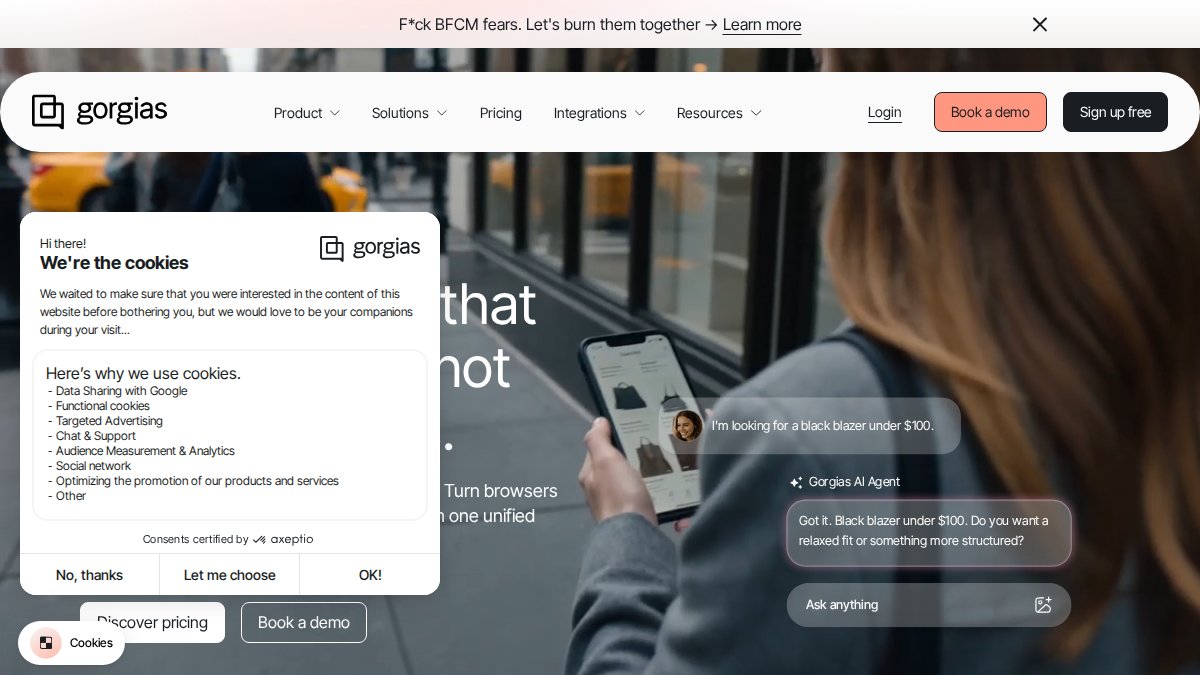
Gorgias: Helpdesk-First Automation
Gorgias consolidates email, chat, and social media into a single inbox with AI automation for repetitive tickets. It integrates directly with Shopify, letting agents edit orders, process refunds, and check shipping status without leaving the helpdesk.
The AI Agent handles up to 60% of tickets autonomously, learning from past interactions and applying that logic to new tickets. The remaining 40% escalate to humans with full context pre-loaded.
Gorgias pricing starts at $10/month for the helpdesk, with AI Agent billed separately per resolution. What works: Seamless Shopify integration and multi-channel consolidation. What doesn't: Voice and SMS require additional add-ons and increase costs.
Yuma AI: Resolution-Focused Support
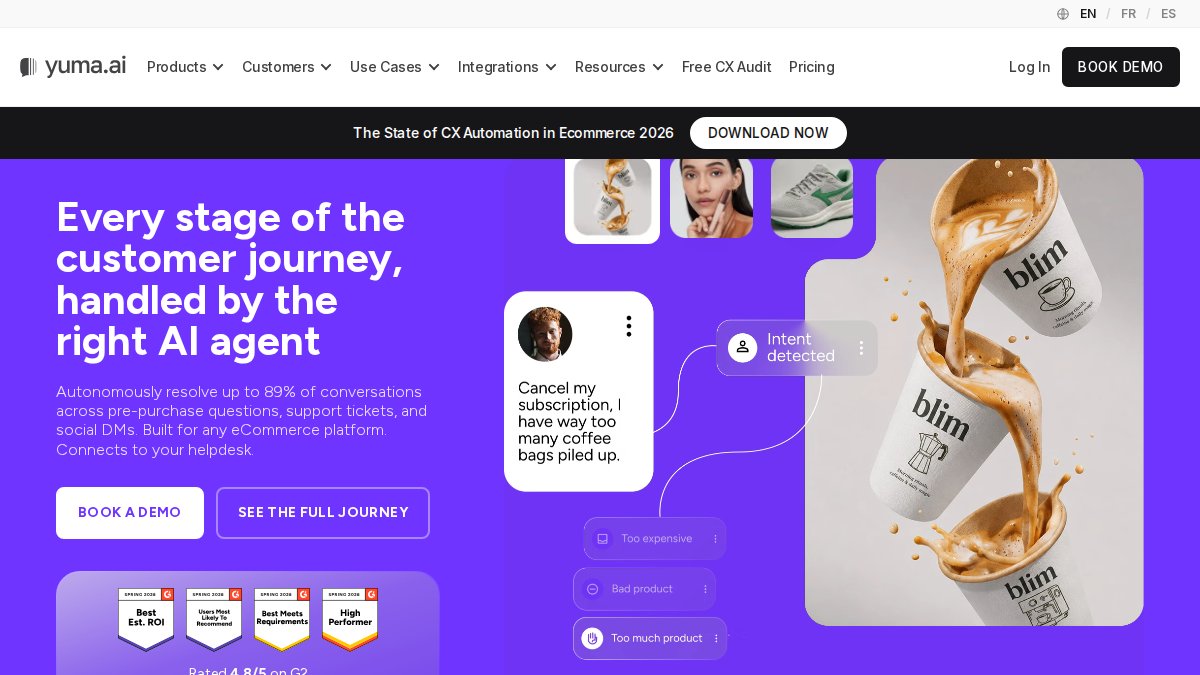
Yuma AI plugs into your existing helpdesk (Shopify, BigCommerce, Gorgias, Zendesk) and handles complex issues autonomously: refunds, exchanges, order edits, returns processing. It resolves issues end-to-end, with some deployments reporting automation rates above 80%.
Pricing is quote-based, requiring sales conversations for cost clarity. What works: Retail-specific workflows mean better understanding of ecommerce business rules. What doesn't: Quote-based pricing lacks upfront transparency.
Ringly.io: Voice Agent for Phone Support
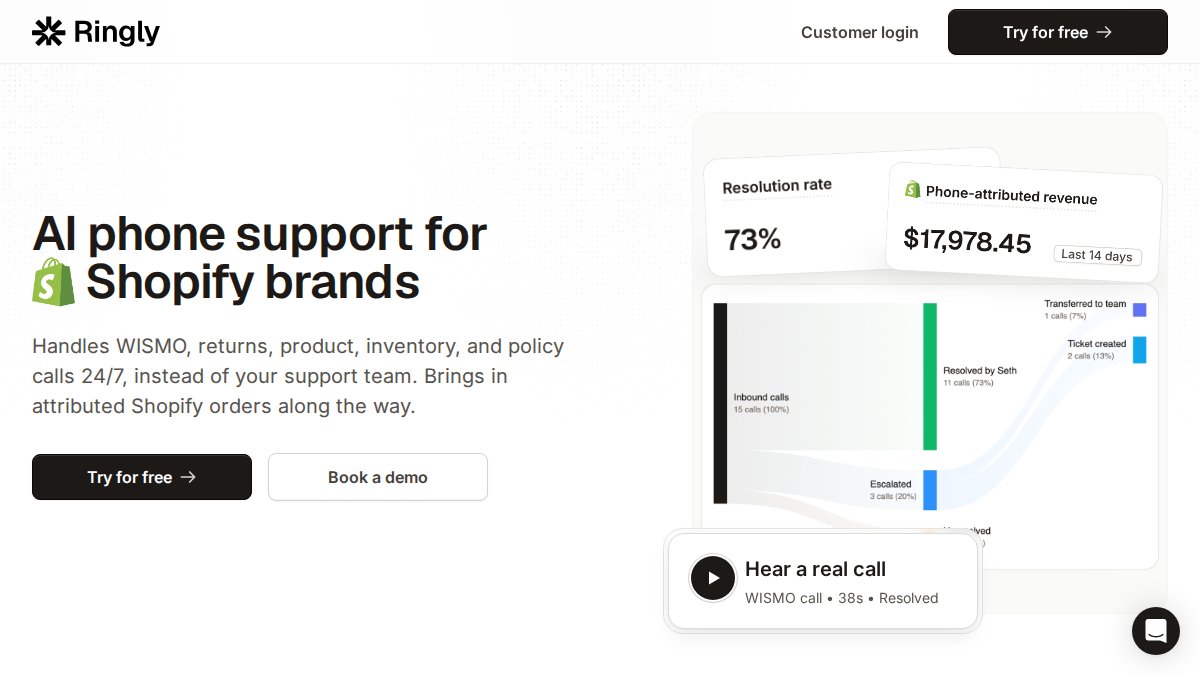
Ringly.io automates inbound phone support. The AI agent answers calls 24/7, handles order lookups, processes returns, and answers product questions, escalating complex issues to humans. For brands receiving 20-50 daily calls, this eliminates dedicated phone support staff and ensures instant answering.
Pricing is custom-quoted based on call volume and complexity. What works: Native Shopify integration enables fast setup. What doesn't: Voice-only focus requires separate tools for chat or email.
Klaviyo: Retention and Predictive Marketing
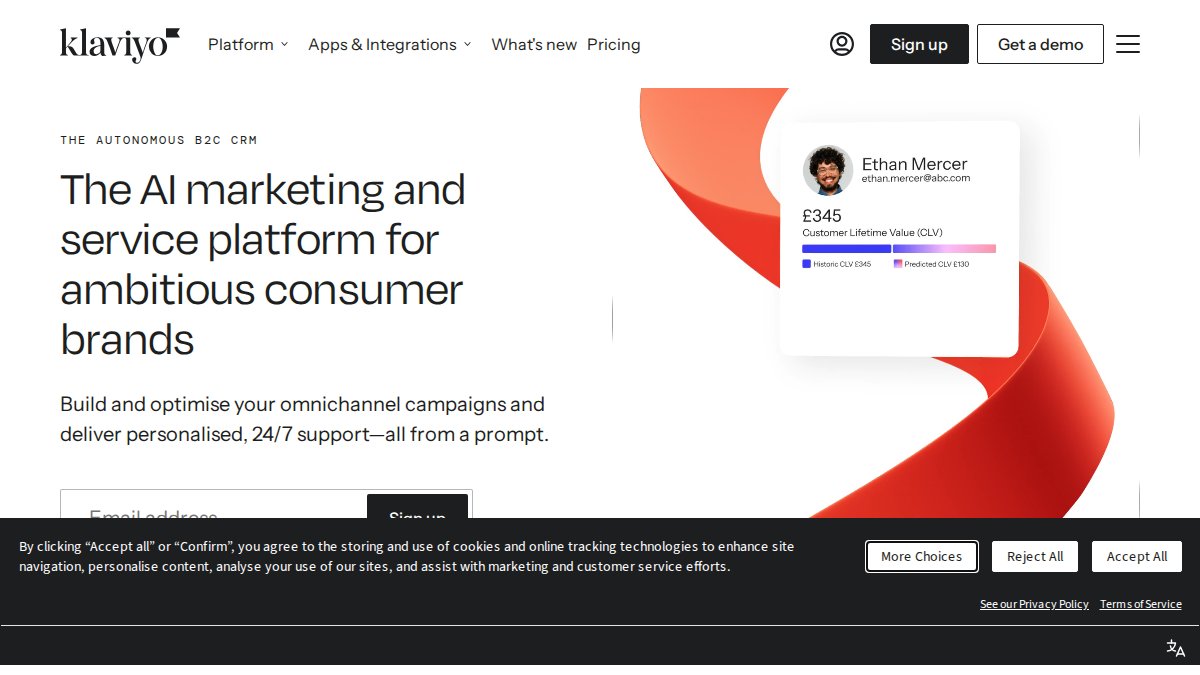
Klaviyo dominates ecommerce email and SMS marketing. It integrates natively with Shopify and uses AI for segmentation, personalization, and predictive analytics. Klaviyo triggers sequences based on customer behavior and identifies which customers respond to discounts versus product recommendations.
Klaviyo offers a free tier for up to 250 contacts and 500 monthly sends. What works: Email and SMS templates designed for ecommerce with pre-built flows. What doesn't: Expensive at scale and focuses on email and SMS only.
Uberwood Agency: Fully Managed Custom AI
Uberwood Agency designs, builds, and operates custom AI systems tailored to your specific business. The advantage is customization, unique workflows, specific integration needs, or complex business rules are handled better by custom solutions. Uberwood designs AI agents understanding your return policy, shipping zones, product catalog, and brand voice, integrating with your existing tech stack and operating them over time.
The "fully managed" aspect is critical, you're hiring a partner who handles implementation, monitoring, optimization, and escalation support. The trade-off is cost and timeline. Custom implementation takes longer and costs more upfront, but ROI is often higher for high-volume or complex operations.
What works: Complete customization built for your business with dedicated partner support. What doesn't: Higher upfront investment and longer implementation timeline.
AI Automation Agency Pricing Models Explained
Per-resolution pricing aligns cost with value, you pay only when the AI produces a result. The downside is unpredictability; volume spikes increase costs.
Tiered subscription pricing creates predictable costs based on contact list size or message volume. You pay for capacity, encouraging greater platform use.
Custom retainer pricing charges a monthly or annual fee for a dedicated team designing, building, and operating your AI systems. This works best for ongoing needs and long-term partnerships.
Hybrid pricing combines elements above: base retainer plus per-resolution costs plus advanced feature fees.
Focus on total cost of ownership, not headline numbers. A cheap tool requiring 10 hours weekly of internal management might cost more than an agency handling everything.
AI Automation Agency Case Studies and Results
An ecommerce brand receiving 5,000 monthly support inquiries reduced response time from 24 hours to under 2 minutes with helpdesk AI automation. The AI handled 65% autonomously while the brand reduced support headcount from 6 to 3 and improved customer satisfaction.
A D2C brand implementing abandoned cart recovery captured an additional $150K in annual revenue from otherwise-lost carts with minimal automation costs.
Success depends on implementation quality, ongoing optimization, and realistic expectations. An AI agent won't fix broken products or terrible return policies, it handles routine interactions efficiently, freeing your team for complex issues and relationship-building.
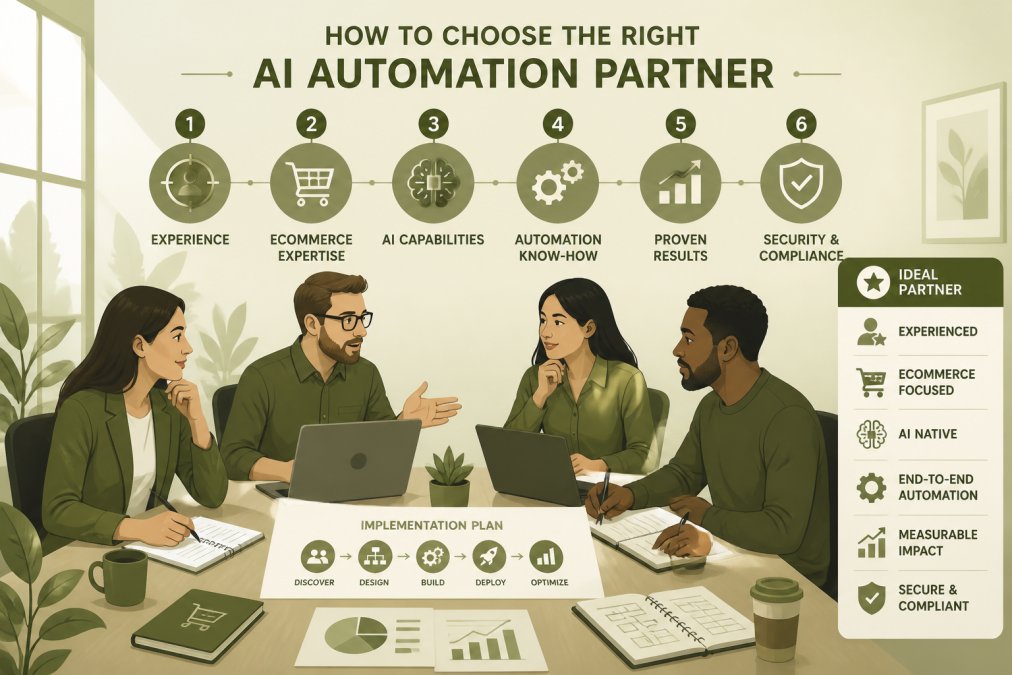
How to Choose the Right AI Automation Partner
Choosing between off-the-shelf tools and fully managed agencies requires honest assessment of your technical capacity, budget, complexity, and timeline.
Custom vs. Off-the-Shelf: What Fits Your Budget
Off-the-shelf tools are cheaper upfront and faster to implement. Gorgias, Klaviyo, and Yuma AI are live within weeks with predictable, scalable costs. This works if your needs fit the tool's design. Standard Shopify stores with typical ecommerce workflows find these tools handle 90% of needs.
Custom agencies cost more upfront and take longer but deliver better ROI for complex workflows, unique integrations, or high-volume operations. Decision framework: start with off-the-shelf tools if your needs are standard. If you hit limitations, evaluate a custom agency.
Security, Compliance, and Data Privacy
AI systems handle sensitive customer data: names, emails, order history, payment information. Established platforms (Gorgias, Klaviyo, Yuma AI) are typically SOC 2 Type II certified and comply with GDPR and CCPA. For AI systems, data privacy concerns center on what data the system accesses and how it's used for model training.
Fully managed agencies like Uberwood should have clear data handling policies and security certifications. Ask about SOC 2 compliance, data isolation, and how your data is used for model training.
Human-in-the-Loop Workflows and Support
The best AI systems don't aim for 100% automation, they handle routine tasks and escalate complex issues to humans. A customer requests a refund. The AI evaluates it against your return policy. Straightforward cases are approved and processed. Ambiguous cases escalate to humans for judgment.
When evaluating tools or agencies, ask about escalation processes. How quickly do escalations reach humans? Can the AI provide context? Is there a queue or immediate attention? Also ask about monitoring and support. What happens if the AI makes a mistake? Good agencies monitor continuously, flag issues, and fix them proactively.
Conclusion
An AI automation agency for ecommerce bridges the gap between off-the-shelf tools and fully custom engineering. The decision between tools and agencies depends on your needs, budget, and technical capacity.
For most ecommerce brands, starting with platforms like Gorgias, Klaviyo, and Yuma AI is right. They're affordable, fast to implement, and handle standard workflows well. As you scale or hit limitations, a fully managed partner like Uberwood Agency becomes valuable, designing, building, and operating custom AI systems that integrate seamlessly with your stack and evolve with your business. Ready to explore what's possible? Get A Free Estimate Quote And Book A Call Today to discuss your specific automation needs and see how AI can transform your ecommerce operations.
| Tool | Starting Price | Best For | Automation Approach |
|---|---|---|---|
| Gorgias | $10/month | Shopify stores needing helpdesk + AI | Per-ticket AI automation |
| Yuma AI | Quote-based | Complex retail workflows | End-to-end issue resolution |
| Ringly.io | Quote-based | Phone support automation | Voice agent with escalation |
| Klaviyo | Free tier | Retention marketing & email | Predictive segmentation |
| Uberwood Agency | Custom retainer | Complex integrations & custom workflows | Fully managed end-to-end |
Frequently Asked Questions
What does an AI automation agency do for ecommerce?
An AI automation agency designs, builds, and manages custom AI systems that handle repetitive ecommerce tasks: customer support via voice agents and chatbots, cart recovery, order status inquiries, returns processing, and predictive analytics for inventory and pricing. Unlike off-the-shelf tools, a fully managed agency handles technical implementation, ongoing monitoring, and system maintenance, allowing you to focus on strategy and growth while they manage the technical heavy lifting.
How much does it cost to hire an AI automation agency?
AI automation agency pricing varies widely based on scope, customization, and integration complexity. Off-the-shelf tools for ecommerce range from $10-$250+ monthly, while custom agency solutions typically operate on project-based or retainer models. Pricing depends on your specific workflows, integration requirements, and support level. Request a quote from agencies to understand costs for your exact use case rather than relying on industry averages.
Is AI automation worth it for small ecommerce businesses?
Yes, if you're losing leads or spending significant time on repetitive customer inquiries. Small stores with 15-50 daily customer interactions see the fastest ROI: automating phone support, chat, and email frees internal time and captures missed leads. However, evaluate your actual pain points first. If you're already handling volume efficiently, the investment may not justify the return. A free audit from an agency can clarify whether automation solves your specific bottleneck.
What are the best AI tools for ecommerce automation?
Top options include Gorgias for helpdesk-native automation with Shopify integration, Yuma AI for complex support resolution, Ringly.io for voice agent phone support, Klaviyo for retention and predictive marketing, and Jasper for product description generation at scale. For fully managed solutions, agencies like Uberwood, Epiphany Dynamics, and Technoboost deliver custom implementations. Choose based on your specific need: customer support, marketing automation, content generation, or end-to-end operations.
What are the risks of using AI automation in ecommerce?
Common risks include AI hallucinations or incorrect order information if systems lack proper guardrails, integration failures with existing tools, data privacy violations if customer information isn't properly secured, and over-automation leading to poor customer experience when complex issues aren't escalated to humans. Mitigate these by choosing agencies with human-in-the-loop workflows, compliance expertise, and proven monitoring systems. Always test automation on non-critical processes first.