
Table of Contents
- What Are Managed AI Solutions for Growing Businesses?
- Why Growing Businesses Need Managed AI Solutions Now
- Key AI Applications for Home Services, E-Commerce, and Professional Firms
- AI Consulting for Small Business: Finding the Right Partner
- Cost of AI for Small Business: Understanding Your Investment
- AI Implementation Challenges Small Business Owners Face
- Best AI Tools for Small Business: Platform Options and When to Use Them
- Implementation Roadmap: Getting Started with Managed AI Solutions
Last Updated: July 30, 2026
What Are Managed AI Solutions for Growing Businesses?
Managed AI solutions handle the engineering, deployment, and ongoing optimization of AI systems on your behalf, eliminating the need for internal data science teams. Rather than buying software and configuring it yourself, you're buying a service where AI engineers build, deploy, integrate, and monitor the system continuously.
A managed AI solution typically includes voice agents that answer calls and route leads, chatbots that handle customer inquiries, marketing automation that nurtures prospects, and predictive analytics that forecast sales trends. The key advantage: you're not managing AI infrastructure while already stretched thin managing operations, closing deals, and keeping customers happy.
Why Growing Businesses Need Managed AI Solutions Now
Adding a full-time employee costs $50,000-$80,000 annually plus benefits, training, and equipment. A voice agent handling 100 inbound calls daily costs a fraction of that while working 24/7 without vacation or sick days.
Growing businesses face a specific constraint: too big to ignore operational inefficiencies, but too small to afford large support teams. A plumbing company can't hire a dedicated receptionist for peak season. An e-commerce store can't staff customer service across time zones. A professional services firm can't afford manual CRM logging for every client interaction.
Managed AI solutions solve this directly. They scale with your business without scaling headcount proportionally. When you get busier, the system handles more volume automatically.
Efficiency and Productivity Gains
Teams implementing voice agents typically see 40-60% reduction in time spent on lead intake. E-commerce stores using chatbots reduce support ticket volume by 30-50%. Marketing teams automating lead nurturing report 25-35% faster sales cycles.
When repetitive work is automated, your team's cognitive load drops. People make better decisions when not exhausted from answering the same questions repeatedly. They close more deals because they're focused on revenue-generating work.
Cost Reduction Without Hiring
A home services company with 50 incoming calls daily during peak season pays roughly $35,000 annually for a dedicated intake coordinator. A managed voice agent system costs a fraction of that while handling 100% of call volume without fatigue or scheduling constraints.
Secondary cost reductions cascade across your operation. When your CRM is populated automatically by AI systems instead of manual data entry, you eliminate transcription errors. When marketing automation sequences run on AI logic, you reduce repetitive tasks.
Scalability as You Grow
Managed AI solutions scale without architectural changes. When your business doubles, your AI system handles increased volume automatically. You don't need to redesign infrastructure, hire technical staff, or migrate platforms.
This matters because growing businesses can't afford downtime during growth phases. A managed solution ensures uptime, handles scaling, and maintains performance as volume increases.
Key AI Applications for Home Services, E-Commerce, and Professional Firms
Voice Agents and Call Routing for Lead Capture
A voice agent answers your phone, qualifies callers, and routes them appropriately. For home services, this means answering service area questions automatically. For professional firms, this means capturing contact information before human involvement.
Plumbing companies report voice agents reduce time to first human contact by 70%. Since lead quality degrades rapidly, a 30-minute response delay can mean losing customers to competitors. When your voice agent answers immediately and qualifies leads, conversion rates increase noticeably.
Chatbots and Customer Service Automation
Chatbots handle text-based interactions, website chat, SMS, Facebook Messenger, excelling at FAQ questions, order status updates, and initial problem diagnosis. The best chatbots handle the 80% of inquiries following predictable patterns, freeing your team for the 20% requiring judgment.
E-commerce stores using chatbots report 25-40% reduction in support ticket volume and significantly faster response times. Customers appreciate instant answers, even if that response is "I'm connecting you to a human now."
Marketing Automation and Lead Nurturing
Marketing automation sends targeted messages based on customer behavior. When someone downloads your lead magnet, they automatically receive a welcome email. If they don't open it, they get a follow-up. This logic runs automatically, 24/7, without human intervention.
Businesses using marketing automation report 50% faster sales cycles and 40% higher conversion rates compared to manual campaigns. A three-person marketing team using automation can nurture as many leads as a 10-person team without it.
Sales Forecasting and Predictive Analytics
Predictive analytics use historical data to forecast future outcomes, which leads convert, which customers churn, or next quarter's revenue based on current pipeline. For growing businesses, this reduces guesswork from financial planning.
After 90 days of operation, most businesses report forecasting accuracy within 10-15% of actual results.
AI Consulting for Small Business: Finding the Right Partner
The difference between successful and failed managed AI implementations often comes down to the consulting partner. You need someone who understands your specific business, not someone selling generic solutions.
The right partner asks questions before recommending solutions: What's your current tech stack? What problems cost you the most time and money? What's realistic to implement in 90 days? Look for experience with businesses similar to yours. A consultant who's built voice agents for 20 plumbing companies understands your specific challenges.
The relationship structure matters too. You want a partner invested in your long-term success, not someone who sells and disappears. Managed AI requires ongoing optimization, monitoring, and adjustments as your business evolves.
Cost of AI for Small Business: Understanding Your Investment
Pricing for managed AI solutions varies based on what you're implementing and customization required. A simple chatbot costs less than a fully integrated voice agent system.
Transparent Pricing Models for Growing Businesses
The best providers offer transparent pricing that scales with usage. You might pay a base fee plus variable costs based on call volume, chat interactions, or marketing sends. This aligns incentives, the provider benefits when you're successful.
When evaluating pricing, look beyond the headline number. Ask about setup costs, integration costs, training costs, and exit costs if you need to switch providers. Total cost of ownership often differs significantly from advertised monthly fees.
ROI Calculation and Payback Period
A voice agent system costing $2,000 monthly but saving 40 hours weekly of intake work generates obvious ROI. Forty hours at $25/hour equals $1,600 in labor savings weekly, or roughly $6,400 monthly.
The payback period for most managed AI implementations falls between 60-120 days. After that, you're operating with improved efficiency indefinitely.
| Metric | Typical Range | Impact |
|---|---|---|
| Setup Time | 2-4 weeks | Minimal disruption to operations |
| Time to ROI | 60-120 days | Quick payback validates investment |
| Monthly Cost Savings | $3,000-$15,000 | Varies by business size and use case |
| Improvement in Lead Response Time | 50-80% faster | Directly improves conversion rates |
AI Implementation Challenges Small Business Owners Face
Data Governance and Security Concerns
Your AI system will handle sensitive data, customer information, sales conversations, financial details. This data needs proper protection without creating friction that makes the system unusable.
The best managed AI providers handle data governance as a core responsibility. They encrypt data in transit and at rest, limit access based on role and need, maintain audit logs, and comply with relevant regulations (GDPR, CCPA, HIPAA).
When evaluating providers, ask about security certifications, compliance status, data backup procedures, and their response protocol for security breaches.
Integration with Existing Tech Stacks
Your business already uses multiple systems, CRM, email, payment processor, accounting software. A managed AI solution needs to integrate cleanly with these existing systems, not replace them or create silos.
Integration complexity depends on your current tech stack. Popular platforms like HubSpot, Shopify, or QuickBooks have pre-built integrations. Niche or older systems may require custom work.
Avoiding AI Hallucinations and System Failures
AI systems sometimes generate plausible-sounding but incorrect information. The best protection is building guardrails, constraining the AI to information you've explicitly provided rather than general knowledge.
A good managed AI provider monitors systems continuously and fixes problems before they impact customers, maintaining redundancy so if one component fails, another takes over automatically.
Best AI Tools for Small Business: Platform Options and When to Use Them
Fully Managed, End-to-End Solutions vs. Self-Managed Platforms
A fully managed solution means engineers build, deploy, and operate the system on your behalf. You describe what you need; they handle everything else. This minimizes your involvement but typically costs more.
A self-managed platform means you buy software and configure it yourself. You have more control and typically pay less, but you're responsible for setup, integration, and maintenance. For most growing businesses without dedicated technical staff, fully managed solutions make more sense.
Cloud-Based AI Services from Major Providers
Major cloud providers like AWS AI Services, Google Cloud AI Solutions, and Microsoft Azure AI offer comprehensive AI services. These platforms provide building blocks, speech recognition, natural language processing, machine learning models, that partners assemble into solutions.
These platforms work well when your managed AI provider uses them as their foundation, giving you the reliability and scalability of major cloud providers combined with customization and support from a specialized firm.
Custom AI Development and Consulting Firms
Specialized AI consulting firms focus exclusively on building custom AI solutions for specific industries. They understand your business nuances and can build systems tailored precisely to your needs.
Custom development takes longer and costs more than pre-built solutions, but for businesses with unique requirements, it's the only approach that works well.
Uberwood Agency specializes in custom AI solutions, designing, engineering, and operating systems tailored to your specific business. Our fully managed model means you don't need to hire technical staff; we manage the system end-to-end.
Implementation Roadmap: Getting Started with Managed AI Solutions
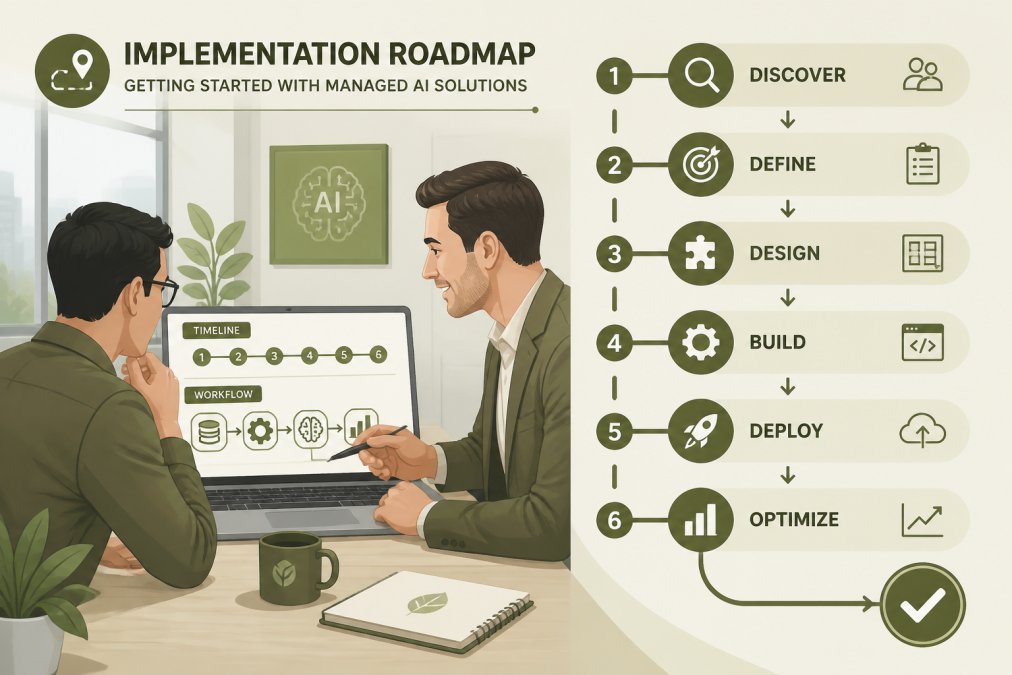
Step 1: Audit Your Current Operations and Identify Pain Points
Examine where your business wastes time or money. Where do team members spend hours on repetitive work? Where do you lose leads because you can't respond fast enough? Document these pain points specifically with metrics.
This audit typically takes one week. You're identifying 2-3 high-impact areas where AI automation would create meaningful improvement.
Step 2: Define Clear AI Use Cases and Success Metrics
Define specific use cases instead of vague goals. For each use case, define success metrics upfront, response time, ticket volume, lead quality, conversion rate, or team time savings.
This step typically takes one week and involves collaboration with your team and managed AI provider.
Step 3: Select the Right Managed AI Partner and Solution Type
Evaluate partners based on experience with similar businesses, process clarity, and cost transparency. Ask for references and case studies with actual results. This evaluation typically takes 2-3 weeks.
Once selected, you'll work together on solution design, typically taking 2-4 weeks, resulting in detailed specifications of what the system will do and how it will integrate.
Step 4: Integrate with Existing Systems and Test Thoroughly
Implementation involves building the AI system, connecting it to existing platforms, and testing thoroughly before going live. This phase typically takes 4-6 weeks.
Your managed AI provider handles technical work. Your team tests in realistic scenarios and provides feedback. Problems discovered during testing are cheap to fix; problems discovered after launch damage customer trust.
Step 5: Monitor, Optimize, and Scale
Once live, monitoring and optimization become ongoing responsibilities. After 30 days, you'll have data showing performance. After 90 days, you'll have enough data to calculate actual ROI.
This optimization cycle continues indefinitely as your business changes and your AI system adapts.
Growing businesses face a choice: hire more people to handle increasing operational complexity, or implement managed AI solutions that scale without proportional headcount growth. The economics strongly favor the latter, particularly for businesses in home services, e-commerce, and professional services where customer communication is frequent and often repetitive.
A managed AI solution handles voice agents that answer calls and qualify leads, chatbots that resolve customer inquiries, and marketing automation that nurtures prospects, all integrated seamlessly with your existing systems. You focus on closing deals and serving customers while the AI provider manages technical complexity. This approach has generated measurable results: faster lead response times, reduced support costs, and improved customer satisfaction. Get A Free Estimate Quote And Book A Call Today to see how managed AI solutions could work for your specific business.
Frequently Asked Questions
What are managed AI services and how do they differ from self-managed platforms?
Managed AI services provide fully handled, end-to-end AI solutions where a vendor designs, deploys, and operates the entire system, including voice agents, chatbots, and custom integrations, while you focus on business growth. Self-managed platforms require your team to build and maintain the AI systems yourself. Managed services eliminate the need for internal technical expertise and provide 24/7 support, making them ideal for growing businesses without dedicated AI staff.
How much does AI consulting for small business typically cost?
AI consulting costs vary based on scope, complexity, and engagement type. Freelance AI developers charge $60-$150+ per hour, while enterprise consulting firms require custom quotes. Fully managed solutions scale with your business needs. Rather than fixed pricing, focus on ROI: calculate time saved, leads captured, and revenue gained. Request a free estimate from your chosen provider to understand costs specific to your use case and business size.
What are the main AI implementation challenges small business owners face?
Common challenges include data security and privacy compliance, integrating AI with existing CRM and ERP systems without disrupting workflows, preventing AI hallucinations or misrouted customer interactions, and managing change across your team. Managed AI solutions address these by handling integration, security governance, and ongoing monitoring. Working with an experienced partner reduces risk and ensures your AI system stays accurate and reliable as you scale.
Can managed AI solutions integrate with systems like HubSpot and other tools we already use?
Yes, quality managed AI solutions integrate seamlessly with popular platforms like HubSpot, Zapier, and other business tools. During implementation, your AI partner should audit your existing tech stack and build custom connectors to ensure data flows smoothly between systems without manual syncing. This integration is critical, poor integration creates duplicate work and data inconsistency. Confirm integration capabilities before selecting a provider.
This article was written using GrandRanker