
Table of Contents
- Benefits of AI Voice Agents: An Overview
- 1. Deliver 24/7 Availability Without Staffing Overhead
- 2. Reduce Operational Costs and Agent Burnout
- 3. Accelerate Response Times and First Call Resolution
- 4. Scale Effortlessly During Peak and Seasonal Demand
- AI Voice Agent Use Cases Across Industries
- AI in Customer Service: Personalization and Data-Driven Insights
- AI Voice Agent Implementation: Security, Compliance, and ROI
Last Updated: July 24, 2026
Benefits of AI Voice Agents: An Overview
AI voice agents deliver far more than simple automation. Businesses implementing voice AI systems experience fundamental operational shifts, handling customer interactions at scale while teams focus on closing deals and growing revenue.
Modern AI voice agents powered by natural language processing understand context, handle complex routing, and deliver personalized responses without human intervention. Unlike earlier chatbots, they learn from interactions and improve over time, creating compounding advantages as call volume increases.
The transformation spans three dimensions: operational cost reduction, customer experience improvement, and team capacity liberation.
1. Deliver 24/7 Availability Without Staffing Overhead
Round-the-clock availability traditionally required hiring night-shift staff or accepting missed calls after hours. AI voice agents eliminate this trade-off entirely.
Your system answers calls at 2 AM on Sunday with the same quality as Monday morning. There's no fatigue, scheduling complexity, or overtime costs. A plumbing company capturing emergency calls that would have been missed now converts those urgent moments into revenue opportunities.
For field service businesses, this means capturing leads when customers need help most. A homeowner's pipe bursts at 11 PM Saturday. Your AI agent answers, gathers information, confirms availability, and schedules a callback. That customer never calls your competitor.
Scalability during peak and seasonal demand follows naturally. When summer call volume triples, your infrastructure scales without hiring temporary staff. When winter slows down, you're not paying idle workers. Cost structure becomes variable instead of fixed.
2. Reduce Operational Costs and Agent Burnout
A full-time support agent costs between $40,000-$60,000 annually with salary, benefits, training, and overhead. Multiply by a team of 5-10 people, and the expense becomes substantial. AI voice agents handle routine inquiries, appointment scheduling, service area confirmation, and basic troubleshooting without fatigue.
This doesn't eliminate human agents, it redirects them. Your team stops answering repetitive calls and starts handling complex situations where human judgment creates value. An agent previously spending 60% of their day on routine calls now spends 80% on problem-solving, upselling, and relationship-building.
Agent burnout drops measurably when work becomes more meaningful. Handling the same appointment-scheduling call repeatedly is soul-crushing. Solving unique customer problems is engaging. Retention improves because the job becomes better.
Properly configured voice agents deflect 40-60% of inbound call volume. That's calls being resolved without human involvement, freeing your team for higher-value work. Training costs also decrease, your AI agent requires configuration, not weeks of onboarding.
3. Accelerate Response Times and First Call Resolution
Wait times destroy customer satisfaction. Every second a customer holds is a second they're reconsidering whether to call you instead of a competitor. AI voice agents answer immediately.
First call resolution (FCR) measures whether a customer's issue gets solved on their first interaction without needing a callback. When properly integrated with your CRM and systems, AI agents have complete visibility into customer history, account status, and available solutions.
A customer calls about scheduling follow-up service. The AI agent checks your calendar, confirms availability, verifies the service address, collects payment information, and confirms the appointment in 90 seconds. The customer hangs up with a confirmation number. That's first call resolution.
For routine inquiries, speed is immediate. Can you service a specific zip code? The agent knows instantly. Does a warranty cover a repair? The system accesses that information in real-time. Response time drops from "we'll call you back" to "here's your answer now."
4. Scale Effortlessly During Peak and Seasonal Demand
Seasonal businesses face a staffing dilemma: hire temporary staff for peak season (expensive and training-intensive) or run understaffed (missed calls, frustrated customers). AI voice agents flip the economics.
Your infrastructure scales automatically to handle 10 calls per minute during peak season or 10 calls per hour during slow season. Cost scales with usage, not headcount.
A home services company experiencing 70% of annual revenue in four months can scale their AI system for that period and reduce costs automatically when the season ends. Call quality remains consistent year-round because you're not overloading human agents.
AI Voice Agent Use Cases Across Industries
Home Services and Field Operations
Home services businesses benefit disproportionately from AI voice agents because call patterns are predictable and customer inquiries follow consistent patterns.
A homeowner calls with a problem. They need to know: Do you service my area? When can you come out? What will it cost? An AI agent answers all questions in 2-3 minutes and schedules an appointment. Your team receives a qualified lead with all necessary information pre-collected.
Routing becomes intelligent. A customer in the north service area routes to your northern crew. An emergency call gets flagged as high-priority. Your dispatcher receives perfectly organized information instead of raw call notes.
Callbacks become optional. The AI agent collected information, confirmed availability, and scheduled the appointment. Your team has everything needed to show up and perform the work.
E-Commerce and Retail
E-commerce businesses receive calls about orders, returns, shipping, and product questions, ideal use cases for AI voice agents because they're transactional and information-driven.
A customer calls about order status. The AI agent accesses the order system, confirms shipping status, and provides tracking information in 60 seconds. Your support team never touches the interaction.
Returns are handled systematically. The AI agent confirms the return reason, checks eligibility, generates a return label, and sends it via SMS. Your returns department receives organized, pre-approved returns instead of raw inquiries.
A retail operation receiving 200 calls per day during peak season can have an AI agent deflect 60-80 of those calls entirely, freeing your team to handle the remaining 120-140 calls requiring human judgment.
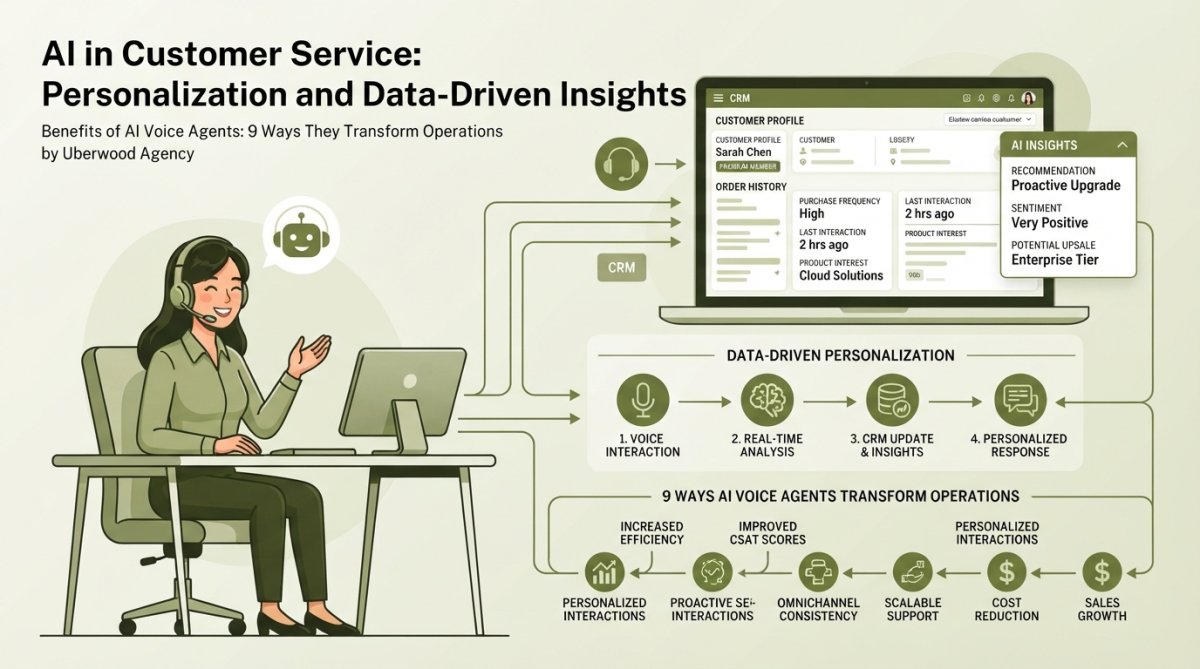
AI in Customer Service: Personalization and Data-Driven Insights
Modern AI voice agents gather data that reveals patterns about your customers and business.
Every call generates structured data: who called, when, what they asked, how long the interaction took, whether they scheduled an appointment. A voice agent handling 500 calls per week generates 26,000 data points per year about customer inquiries, timing patterns, and conversion behavior.
Your team can analyze this data to identify trends: Which service areas generate the most calls? Which times receive highest volume? Which questions appear most frequently? Which customer segments convert most readily?
Personalization emerges from this data. The AI agent recognizes returning customers and adjusts its approach. A customer who previously called about HVAC service receives relevant suggestions about seasonal maintenance.
CRM integration amplifies this effect. Your AI agent pulls customer history from your CRM and adds new interaction data back to it. Each call enriches your customer profile, and your system provides more relevant, personalized service over time.
AI Voice Agent Implementation: Security, Compliance, and ROI
Security and Compliance Risks to Address
Implementing AI voice agents requires addressing security and compliance considerations that many businesses overlook.
Call recording and data storage create compliance obligations. Some states require two-party consent for recording; others require one-party consent. Federal regulations under the Gramm-Leach-Bliley Act apply if you handle financial information. HIPAA applies if you handle healthcare data. Your AI system must respect these requirements automatically.
Your voice agent collects sensitive information: payment details, addresses, phone numbers, service history. This data must be encrypted in transit and at rest, stored securely, and accessible only to authorized systems and personnel.
Integration with existing systems creates additional security considerations. Your AI agent connects to your CRM, appointment system, payment processor, possibly accounting software. Each integration is a potential vulnerability. API keys must be managed securely, data flowing between systems must be encrypted, and unauthorized access must be prevented.
Modern AI voice agent platforms are built with these requirements in mind. A fully managed solution handles the security and compliance infrastructure, letting you focus on configuration rather than regulatory concerns.
Building Your Implementation Roadmap
Implementation means planning the integration carefully so your AI agent works seamlessly with existing systems.
Start with a clear definition of what the AI agent will handle. Will it answer appointment scheduling calls only, or handle returns, technical support, and billing inquiries? Will it route calls to your team or resolve issues autonomously? Scope determines complexity.
Map your existing systems: CRM, appointment system, payment processor, customer databases. The more systems your AI agent integrates with, the more planning required.
Configuration follows: define business rules (service areas, pricing, available slots, escalation criteria) and routing (which calls go to which team members, what triggers escalation). Testing precedes deployment, run the AI agent through typical call scenarios to verify correct handling and system integration.
Deployment happens gradually. Start with a small percentage of incoming calls routed to the AI agent. Monitor performance. Gradually increase the percentage until the AI agent handles your target volume.
A typical implementation timeline is 4-8 weeks from planning to full deployment, depending on complexity.
Calculating ROI and True Business Impact
ROI calculation requires understanding what benefits matter most to your business.
Start with baseline metrics: monthly call volume, average call duration, support staff count, fully-loaded cost per employee. These establish your current state.
If the agent deflects 50% of calls, estimate impact. If each call costs $2 in labor and you receive 1,000 calls monthly, deflecting 500 calls saves $1,000 monthly or $12,000 annually.
Real ROI often comes from revenue impact, not cost reduction. If your AI agent captures 10 additional appointments per month that would have gone elsewhere, and your average appointment value is $200, that's $2,000 monthly or $24,000 annually in incremental revenue.
Combine cost savings and revenue impact. $12,000 in annual savings plus $24,000 in incremental revenue equals $36,000 in total annual impact. If implementation costs $15,000 and ongoing support costs $500 monthly, your payback period is roughly 5-6 months.
| Metric | Baseline | With AI Agent | Monthly Impact |
|---|---|---|---|
| Monthly call volume | 500 | 500 | , |
| Calls handled by AI | 0 | 250 | 250 |
| Support staff required | 3 | 2 | -1 |
| Labor cost per month | $12,000 | $8,000 | -$4,000 |
| Captured emergency calls | 0 | 10 | 10 |
| Revenue from emergency calls | $0 | $2,000 | $2,000 |
| Total monthly impact | , | , | -$6,000 |
The gap between good and great customer service often comes down to availability and responsiveness. AI voice agents close that gap by handling routine interactions instantly and routing complex issues to your team. Benefits extend beyond cost reduction to include improved customer experience, better data for decision-making, and freed-up capacity for your team to focus on high-value work.
If you're ready to implement a voice agent system tailored to your business, consider reaching out to discuss your specific needs. Get A Free Estimate Quote And Book A Call Today to explore how a custom AI voice agent can integrate seamlessly with your existing workflow while your team focuses on closing deals and growing revenue.
Frequently Asked Questions
What are the main advantages of using AI voice agents for small businesses?
AI voice agents deliver three core advantages for small teams: they handle routine incoming calls and customer inquiries 24/7 without hiring additional staff, they reduce operational costs by automating repetitive tasks, and they free your team to focus on high-value work like closing deals. For a 15-20 call-per-day home services business, voice agents can route calls intelligently, capture service requests, and qualify leads while your team is busy or closed, capturing opportunities you'd otherwise miss.
How do AI voice agents improve customer satisfaction and first call resolution?
AI voice agents powered by natural language processing understand customer intent on the first interaction, reducing transfer delays and wait times. They can access your CRM, service history, and business rules instantly, enabling faster, more accurate responses. This reduces customer frustration and improves first call resolution (FCR) rates. When customers reach a human agent, they're pre-screened and contextualized, so agents solve problems faster, boosting both CSAT and operational efficiency.
What security and compliance risks should I consider before implementing AI voice agents?
Key concerns include customer data privacy (ensuring calls are encrypted and PII is protected), regulatory compliance (HIPAA for healthcare, PCI for payments), and call recording consent. Voice agents must be trained to avoid hallucinating responses or misrouting sensitive inquiries. A fully managed solution handles these risks through built-in security protocols, compliance monitoring, and human-in-the-loop oversight, so your team isn't responsible for managing vulnerabilities alone.
How do I calculate ROI when implementing AI voice agents in my business?
Start by measuring baseline metrics: average calls per month, cost per call (salary + overhead), average resolution time, and customer acquisition cost. Then project improvements: fewer missed calls (captured leads), faster resolution times (reduced agent hours), and reduced hiring/training costs. For example, if you capture 10 additional qualified leads monthly at $50 customer acquisition cost, that's $6,000 annual value. Compare this against implementation and monthly service costs to determine payback period and ongoing ROI.
This article was written using GrandRanker