
Table of Contents
- What Are AI Voice Agents for Service Firms?
- Why Service Firms Need AI Voice Agents Now
- AI Voice Agent Services for Businesses: Key Capabilities
- Top AI Voice Agent Platforms for Service Firms
- Quick Comparison Table
- 1. Uberwood Agency: Done-for-You AI Voice Automation
- 2. Retell AI: Developer-Friendly, Ultra-Low Latency
- 3. PolyAI: Enterprise-Grade Conversational Realism
- 4. Yellow.ai: Omnichannel Automation at Scale
- 5. Genesys Cloud AI: Full Contact Center Suite
- 6. Voiceflow: No-Code Agent Builder for Service Teams
- Best AI Voice Agent for Customer Service: Real-World Use Cases
- AI Call Center Automation: Legal and Compliance Considerations
- AI Receptionist for Startups and Growing Service Firms
- Implementation for Non-Technical Owners: What to Expect
AI Voice Agents for Service Firms: 2026 Guide
Last Updated: July 23, 2026
Service firms lose approximately 30% of inbound calls during peak hours due to insufficient staffing. AI voice agents address this gap by automating call handling, appointment scheduling, and lead qualification without additional headcount. At Uberwood Agency, we've helped dozens of home service companies, consulting firms, and professional service providers deploy custom AI voice systems that handle routine interactions while freeing teams for high-value client work.
This guide covers selecting, implementing, and optimizing AI voice agents for service businesses, including platforms, use cases, compliance considerations, and common implementation mistakes.
What Are AI Voice Agents for Service Firms?
AI voice agents are conversational AI systems that handle inbound and outbound calls using natural language processing and text-to-speech technology. Unlike traditional IVR systems with rigid menu trees, modern voice agents understand spoken language, handle interruptions, and maintain context across complex conversations. These systems combine speech-to-text conversion, large language model processing, and text-to-speech production in real time, typically within 200-400 milliseconds of latency.
How They Differ from Traditional IVR Systems
Traditional IVR systems force callers through branching menus: "Press 1 for appointments, 2 for billing." AI voice agents work differently, callers speak naturally, the agent understands context, and handles variations in phrasing. A traditional IVR might require five menu levels to reschedule an appointment. An AI voice agent handles it in a single conversation without forcing callers to navigate menus.
Why Service Firms Need AI Voice Agents Now
Service firms operate on thin margins with razor-sharp scheduling. A missed call during peak hours means lost revenue and a competitor picking up that lead. Many service businesses operate skeleton crews during evenings and weekends, sending most inbound calls to voicemail.
AI voice agents solve this without hiring additional staff. They handle call volume spikes automatically, qualify leads before reaching your team, and capture appointment requests 24/7. The technology has matured significantly in 2026, current systems reliably handle accents, background noise, and complex requests. Integration with CRM platforms is now standard.
AI Voice Agent Services for Businesses: Key Capabilities
Modern AI voice agent platforms share core features, though implementation depth varies between solutions.
Natural Language Processing and Real-Time Reasoning
Natural language processing allows AI to understand what callers mean, not just their words. A caller might say "I need someone to come look at my AC," "My air conditioning is making a weird noise," or "I'm hot and my unit isn't working." NLP-powered agents understand these are all HVAC service requests. Real-time reasoning means the agent adapts responses based on context and conditional logic, handling multiple issues, pricing questions, and requests for specific technicians while tracking conversation context.
CRM Integration and Automated Workflows
Valuable AI voice agents integrate directly with existing CRM or scheduling systems. When a caller books an appointment, the agent writes it directly to your calendar. When a returning customer calls, the agent pulls their history and service notes. Automated workflows extend beyond the call, triggering follow-up emails, SMS reminders, or internal task assignments. This integration eliminates manual data entry and prevents bookings from being lost.
| Capability | Impact | Implementation Effort |
|---|---|---|
| Natural language understanding | Handles varied caller phrasing without menu navigation | Medium |
| Real-time reasoning | Adapts responses based on context and caller intent | Medium |
| CRM integration | Eliminates manual booking entry and retrieval | Low |
| Workflow automation | Triggers follow-ups and internal tasks automatically | Medium |
| 24/7 availability | Captures calls outside business hours | Low |
Top AI Voice Agent Platforms for Service Firms
Quick Comparison Table
| Platform | Best For | Starting Price | Standout Feature |
|---|---|---|---|
| Uberwood Agency | Done-for-you implementation with custom builds | Custom quote | Fully managed, end-to-end service |
| Retell AI | Developer teams needing ultra-low latency | $0.07/minute | 200ms latency, transparent pricing |
| PolyAI | Enterprise contact centers with complex workflows | Custom (typically $150K+/year) | Human-like voice quality |
| Yellow.ai | Omnichannel automation at scale | Freemium + custom | Generative AI with FAQ automation |
| Genesys Cloud AI | Large contact centers with full CCaaS needs | $75/user/month | Comprehensive workforce management |
| Voiceflow | Legal and professional service firms | Free tier + custom | No-code builder for service intake |
1. Uberwood Agency: Done-for-You AI Voice Automation
Uberwood Agency specializes in designing, engineering, and operating custom AI systems without requiring internal technical resources. You describe your call flows and business rules; Uberwood's team builds a custom system, integrates it with your CRM and scheduling system, and manages it ongoing. This outsources the entire operation, not just software. Pricing is custom-quoted based on complexity, call volume, and integration requirements.
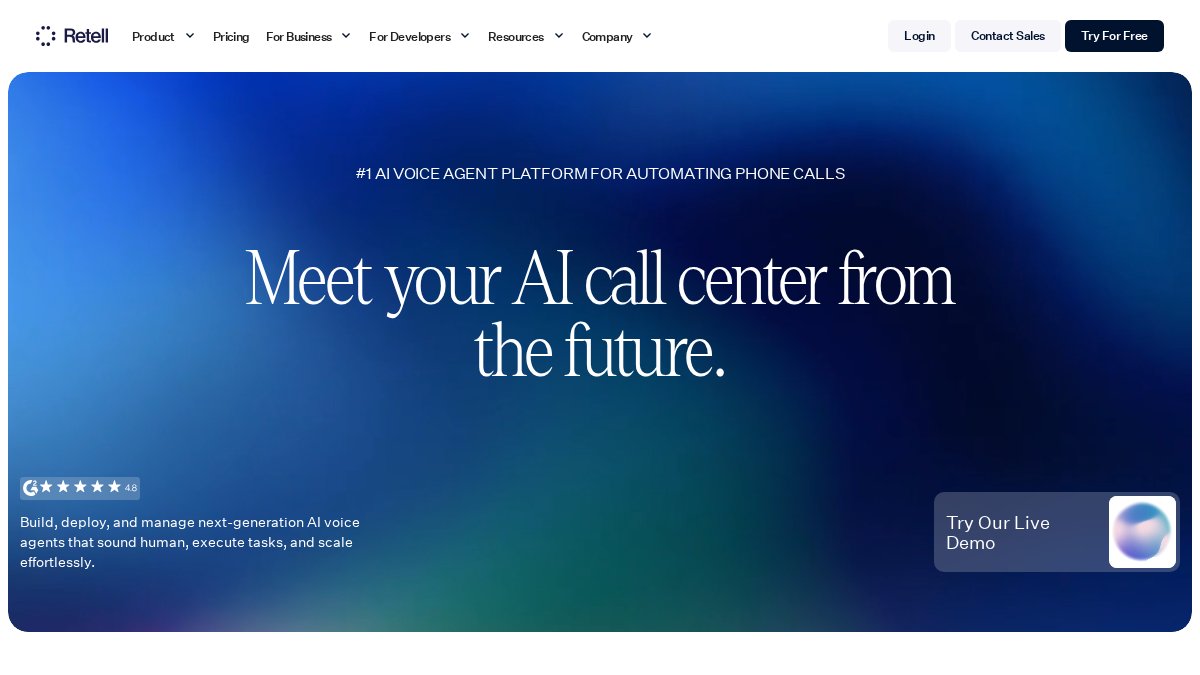
2. Retell AI: Developer-Friendly, Ultra-Low Latency
Retell AI targets technical teams needing programmatic control over their voice AI stack. The platform provides modular pipeline connecting speech-to-text engines, large language models, and text-to-speech systems with APIs for customization. Retell's defining characteristic is 200-millisecond response times, creating conversations that feel genuinely natural. Most competitors sit at 400-800ms, creating noticeable pauses. Pricing is transparent: $0.07 per connected minute plus $2/month per phone number. A typical service firm handling 100 calls monthly at 5-minute average duration pays roughly $35-40 monthly.
3. PolyAI: Enterprise-Grade Conversational Realism
PolyAI focuses on conversational AI that sounds genuinely human. Their voice synthesis handles interruptions, natural pauses, and emotional tone. The system understands context across long conversations and handles complex multi-step requests. PolyAI is built for enterprise contact centers with high call volumes and complex compliance requirements. Pricing typically starts around $150,000+ annually.
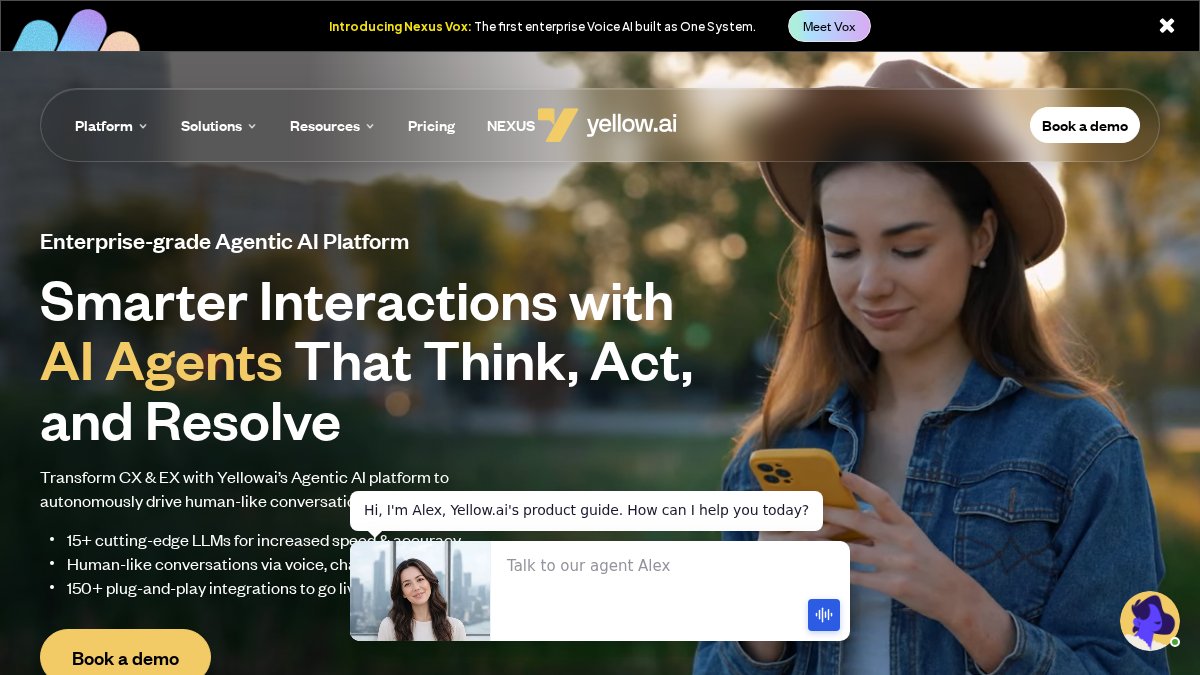
4. Yellow.ai: Omnichannel Automation at Scale
Yellow.ai automates customer interactions across voice, chat, email, and SMS channels. Define automation logic once and deploy across all touchpoints. The platform includes a built-in FAQ module that answers common questions automatically. Yellow.ai offers a freemium tier with unlimited agent seats on the basic plan. Premium pricing is custom-quoted based on conversation volume and features.
5. Genesys Cloud AI: Full Contact Center Suite
Genesys Cloud CX handles call routing, agent assist, workforce scheduling, analytics, and quality management. Pricing starts at $75 per user per month. For a 50-person contact center, that's $3,750 monthly before add-ons. Genesys is an enterprise solution with enterprise pricing best suited for large operations where workforce optimization directly improves profitability.
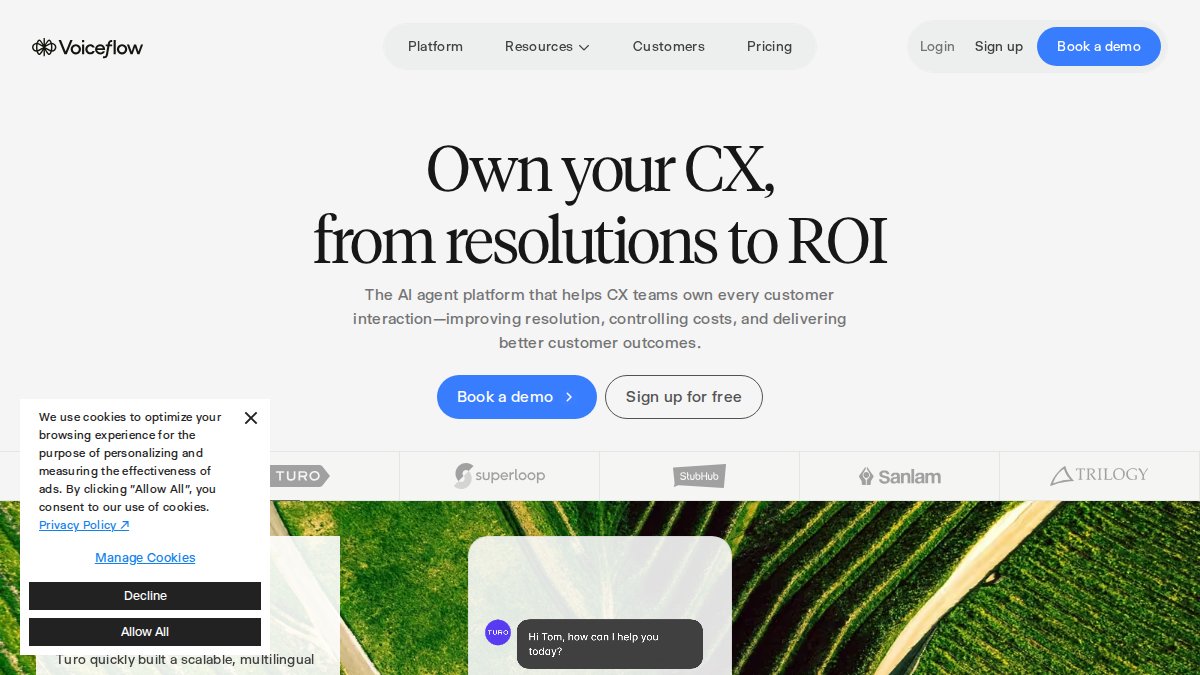
6. Voiceflow: No-Code Agent Builder for Service Teams
Voiceflow is designed for non-technical professionals to build AI agents without coding. The visual builder lets you design call flows by dragging conversation nodes, setting conditions, and mapping integrations. Legal firms, consulting practices, and service businesses use Voiceflow for client intake, appointment booking, and information gathering. Voiceflow offers a free tier with pricing scaled for higher call volumes and advanced features.
Best AI Voice Agent for Customer Service: Real-World Use Cases
Appointment Scheduling and Call Routing
Appointment scheduling is the most common first use case. When a customer calls, the AI agent answers immediately, asks what service they need, checks your calendar for availability, and books the appointment directly into your scheduling system. The agent handles variations in how customers describe services and qualifies location before checking availability. A human receptionist might book 20-30 appointments per day. An AI agent handles the same volume in parallel with zero fatigue and perfect accuracy.
Lead Qualification and High-Intent Prospect Capture
AI voice agents can qualify inbound leads before they reach your sales team. The agent asks discovery questions about the problem, urgency, prior experience, and competing quotes. Based on answers, the agent assigns priority levels. High-intent prospects reach your sales rep immediately; lower-priority leads get scheduled for callback or nurture sequences. This saves your sales team time and improves conversion rates because high-intent prospects reach your team faster, before deciding on a competitor.
Customer Support Automation and First-Contact Resolution
For recurring customers, AI voice agents handle straightforward support requests without human involvement. "I need to reschedule my appointment." "Can you send me a copy of my last invoice?" The agent pulls customer history, handles the request, and documents the interaction in your CRM. First-contact resolution rates improve because the AI instantly accesses your entire knowledge base and customer history without cognitive load.
AI Call Center Automation: Legal and Compliance Considerations
Data Privacy and Call Recording Regulations
AI voice agents record calls by default. Call recording is heavily regulated in the United States. Some states require two-party consent; others use one-party consent. Federal law allows one-party consent, but state laws vary. California, Florida, Illinois, and Pennsylvania require two-party consent.
Your AI agent should state at the beginning of the call: "This call may be recorded for quality and training purposes. By continuing, you consent to recording." Document that disclosure. If the caller hangs up, they've declined. If they stay on the line, you have consent. Protect customer data by transmitting personally identifiable information over encrypted connections and storing it in secure systems. Verify third-party platform security certifications and data handling practices.
Human-in-the-Loop Workflows for Risk Mitigation
The safest approach is human-in-the-loop workflows where AI handles routine calls but escalates complex or sensitive situations to a human immediately. Define clear escalation rules: if a customer becomes upset, escalate immediately. If they're asking about services outside your normal scope, escalate. If they're requesting discounts or exceptions, escalate. This keeps the AI in its lane (routine transactions) while humans handle judgment calls, mitigating liability concerns.
AI Receptionist for Startups and Growing Service Firms
Scalability Without Hiring Additional Staff
The fundamental advantage of AI voice agents is scalability without proportional cost increases. Your first 100 calls per month and first 10,000 calls per month use essentially the same infrastructure. A human receptionist can handle maybe 50-100 calls per day before becoming overwhelmed. For startups and rapidly growing firms, this scalability is critical. Deploy an AI agent to handle routine calls as volume grows. Your receptionist now focuses on complex interactions and relationship building instead of answering the same appointment questions repeatedly. This also enables 24/7 availability without hiring night shift staff.
Integration with Your Existing Tools
The most valuable AI voice agents integrate directly with tools you already use. If you use HubSpot for CRM, the agent writes appointments and lead data directly to HubSpot. If you use Google Calendar, appointments sync automatically. If you use Zapier or Make for workflow automation, the agent triggers those workflows. This integration eliminates manual data entry that kills productivity. Before selecting a platform, verify it integrates with your specific tools. Most major platforms have pre-built connectors for popular CRMs and calendars.

Implementation for Non-Technical Owners: What to Expect
Setup, Training, and Ongoing Support
Self-service platforms like Retell or Voiceflow typically take 2-4 weeks from signup to live deployment. You'll document your call flows, integrate with your CRM, and test extensively before going live. Managed services like Uberwood Agency take 4-8 weeks but you're not doing the work yourself. You describe your needs, the team builds the system, and you review before it goes live. Training is minimal for users, the system runs in the background. What matters is training your team on handling escalated calls.
Common Implementation Mistakes to Avoid
Mistake 1: Trying to automate everything immediately. Start with simple appointment booking. Add lead qualification next. Expand gradually as you see what works.
Mistake 2: Not testing with real calls before going live. Run 50-100 test calls with real people. Listen to recordings. Identify failure patterns and fix them before customers encounter them.
Mistake 3: Forgetting about escalation paths. Define where calls go when the AI agent can't handle something. Test escalation paths thoroughly.
Mistake 4: Underestimating integration complexity. Budget extra time for integration and testing. Data field mismatches and custom CRM fields often cause delays.
Mistake 5: Not monitoring performance after launch. Set up monitoring alerts. Review call recordings weekly. Track booking success rates and escalation frequency. Use that data to optimize.
Implementing AI voice agents for service firms is becoming a competitive necessity. Service businesses that deploy voice automation capture more leads, reduce missed calls, and free their teams to focus on client relationships instead of administrative tasks.
The challenge is choosing the right approach for your business. If you want a fully managed solution where technical complexity is someone else's problem, Get A Free Estimate Quote And Book A Call Today to discuss your specific needs with Uberwood Agency, which specializes in designing and operating custom AI systems that integrate seamlessly with your existing tools. Their done-for-you approach means you get voice automation benefits without internal engineering overhead.
Frequently Asked Questions
What are the main benefits of AI voice agents for small service firms?
AI voice agents reduce missed calls, automate appointment scheduling, qualify leads 24/7, and free your team for high-value work. They handle high call volumes during peak seasons without hiring extra staff. For service firms, this means better customer experience, faster response times, and lower operational costs. Many firms see improved lead capture and reduced administrative burden on reception staff.
How do AI voice agents integrate with CRM systems like HubSpot?
Most modern AI voice agent platforms offer native or API-based CRM integration. They automatically log call details, create customer records, update contact information, and route qualified leads directly into your CRM. This eliminates manual data entry and ensures your team has real-time information. Integration quality varies, some platforms offer seamless, pre-built connectors while others require custom API work.
What compliance and legal risks should service firms know about AI voice agents?
Key concerns include call recording consent (varies by state), data privacy (GDPR, CCPA), and liability if the AI mishandles sensitive information. Service firms should ensure their AI voice agent platform supports state-compliant recording disclosures, encrypts customer data, and maintains audit trails. Human-in-the-loop workflows, where an agent reviews or approves AI decisions, reduce risk significantly and are essential for regulated industries.
Can AI voice agents handle the complexity of service firm routing and scheduling?
Yes, enterprise-grade AI voice agents are designed for complex routing. They understand service areas, technician availability, appointment slots, and customer preferences. They can handle follow-up questions, reschedule calls intelligently, and route to the right department. However, routing complexity depends on your platform choice, managed solutions handle more complexity out-of-the-box, while developer-first platforms require more configuration but offer greater flexibility.
What's the difference between managed AI voice agent services and self-serve platforms?
Managed services (like Uberwood Agency) handle design, deployment, monitoring, and support, your team doesn't need technical skills. Self-serve platforms let you build and manage agents yourself, offering more control but requiring technical expertise or a dedicated person to oversee it. For service firms without in-house engineers, managed solutions reduce risk and ensure 24/7 reliability without internal babysitting.
This article was written using GrandRanker