
Table of Contents
- What AI Automation Does for Ecommerce Stores
- AI Ecommerce Automation Examples That Drive Results
- Top AI Tools for Ecommerce Automation: Quick Comparison
- AI Customer Support for Ecommerce: Reducing Response Time and Costs
- How to Implement AI in Ecommerce: A Roadmap for Store Owners
- Common Integration Challenges and How to Avoid Them
- Conclusion
Last Updated: August 8, 2026
What AI Automation Does for Ecommerce Stores
AI automation handles repetitive tasks, personalizes customer experiences, and captures revenue that would otherwise slip away. It manages customer inquiries instantly, personalizes product recommendations in real time, forecasts inventory, and nurtures leads through automated sequences.
Without automation, abandoned carts go unrecovered, customers see generic experiences, and stockouts happen without warning. With AI, recovery emails deploy automatically within minutes, personalized to browsing history. New visitors see tailored recommendations. Forecasting prevents both stockouts and overstocking.

Stores that automate customer communication, personalization, and inventory management see measurable improvements in conversion rates, customer lifetime value, and operational efficiency. The question isn't whether to automate, it's which processes to prioritize and which tools deliver results.
AI Ecommerce Automation Examples That Drive Results
Cart recovery sequences. Automated emails trigger 1 hour after abandonment, showing exact products viewed with a small discount incentive. Many stores recover 15-25% of abandoned cart revenue this way.
Product recommendation engines. AI analyzes browsing history and purchase patterns to suggest products dynamically on product pages, in carts, and in post-purchase emails. Stores see noticeable increases in average order value.
Lead capture and qualification. Chatbots engage visitors with targeted questions, tagging qualified leads for your team and nurturing browsers automatically.
Customer service automation. AI chatbots handle 50-70% of repetitive inquiries like return policies and order status, freeing your team for complex issues.
Inventory forecasting. AI predicts demand based on historical sales, seasonality, and trends, preventing stockouts and overstocking.
Email segmentation and send-time optimization. AI segments lists by behavior and determines optimal send times for each person, increasing open and click rates.
Dynamic pricing. AI adjusts prices based on demand, inventory, and competitor pricing automatically.
Top AI Tools for Ecommerce Automation: Quick Comparison
| Tool | Starting Price | Free Tier | Best For | Key Strength |
|---|---|---|---|---|
| Uberwood Agency | Custom pricing | No | Fully managed AI systems | Done-for-you implementation with no internal technical team required |
| ManyChat | $14/month | Free (25 contacts) | Social media automation | Multi-channel messaging and chatbot workflows |
| Klaviyo AI | Free-$1,500+/month | Free (250 contacts) | Email and SMS marketing | Predictive analytics and revenue attribution |
| Octane AI | $50/month | No | Personalization and quizzes | Zero-party data collection and product recommendations |
| Tidio (Lyro AI) | $29/month+ | Free (limited) | Live chat and customer support | 24/7 AI support automation |
| Algolia | Free-custom | Free (Build tier) | Product search and discovery | AI-powered search with real-time personalization |
| Jasper AI | $69/seat/month | No | Content creation at scale | Long-form marketing copy and product descriptions |
| ChatGPT Plus | $20/month | Free (limited) | General business tasks | Versatile AI for strategy, copywriting, and data analysis |
| Rebuy | Custom pricing | No | Revenue maximization | AI-driven upsells and cross-sells across customer journey |
| LEAFIO AI | Custom pricing | No | Inventory optimization | Demand forecasting and automated reordering |
1. Uberwood Agency, Best for Fully Managed AI Implementation
Uberwood Agency removes the engineering burden entirely. You describe your bottleneck; they design, deploy, and operate custom AI solutions as a managed service. Uberwood handles everything after launch, eliminating the most common failure point: implementation and ongoing support.
What works: For ecommerce stores without technical teams, this is the difference between "we tried AI automation and it was a mess" and "our AI system just works." Custom builds fit your specific workflow.
What to watch: Pricing is custom. Budget and timeline require a conversation with their team.
Uberwood Agency AI automation solutions
2. ManyChat, Best for Social Media and Messaging Automation
ManyChat automates conversations across Instagram, Facebook Messenger, WhatsApp, TikTok, and SMS. Build chatbot sequences that respond to messages, capture leads, and segment audiences without coding. A customer messages your Instagram asking about a product; ManyChat responds instantly with details and a store link.
What works: The visual flow builder is easy to use. Pre-built templates get you started in minutes. The free tier covers 25 contacts, enough to test before paying.
What doesn't: AI features are a paid add-on. The platform excels at automation workflows but isn't a full customer service solution like Tidio.
3. Klaviyo AI, Best for Email Revenue and Predictive Analytics
Klaviyo is the gold standard for ecommerce email marketing. Predictive analytics identify customers likely to churn and highest-value customers. AI-generated copy suggests subject lines. Segmentation happens automatically based on behavior. Direct integration with Shopify and WooCommerce pulls real-time purchase data for behavior-based personalization.
What works: Revenue attribution is unmatched. Pricing scales with your contact list, so small stores pay far less than large ones.
What doesn't: Costs escalate quickly as your list grows. The free tier caps at 250 contacts. Advanced AI features require higher-tier plans.
4. Octane AI, Best for Personalization and Zero-Party Data
Octane AI creates interactive quizzes that guide customers to the right products while collecting zero-party data. A customer takes a 5-question quiz about their skin type; Octane recommends matched products. This improves customer experience and provides data for future targeting.
What works: Quizzes increase conversions and average order value. Zero-party data integrates with Klaviyo for future targeting.
What doesn't: No free tier. The $50/month starting price assumes serious implementation.
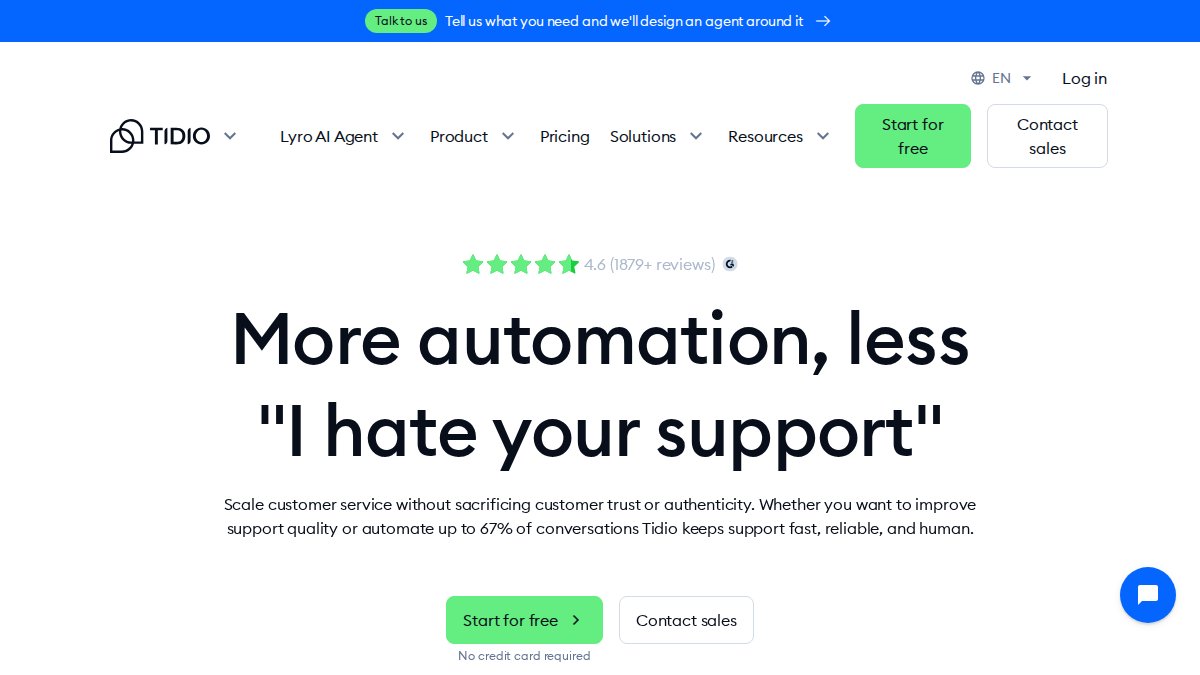
5. Tidio (Lyro AI), Best for 24/7 Customer Support Automation
Tidio combines live chat, chatbots, and a helpdesk. The Lyro AI assistant handles common questions automatically. When a customer asks "Where's my order?", Lyro pulls order data and responds instantly. Complex questions route to your team.
What works: The combination of live chat and AI means you're not choosing between automation and human support. Lyro learns from your responses over time.
What doesn't: Advanced AI features require higher-tier plans. Lyro occasionally misunderstands complex situations.
6. Algolia, Best for AI-Powered Product Search and Discovery
Algolia replaces default search with AI-powered search that understands context, typos, and intent. A customer searching "comfy work shoes" gets results for comfortable professional footwear, even if those exact words don't appear in product titles. The platform also powers personalized recommendations based on browsing and purchase history.
What works: Search quality directly impacts conversion rates. Algolia's AI understands customer intent better than keyword matching. Pricing scales with usage.
What doesn't: Costs scale with traffic volume. High-traffic stores can face surprising overage charges. Implementation requires some technical setup.
7. Jasper AI, Best for Content Creation at Scale
Jasper generates marketing copy, product descriptions, blog posts, and email content. Create product descriptions for 100 new SKUs in hours instead of days. The brand voice feature ensures consistency across all content.
What works: Multiple AI models give you options. Templates for common content types speed up workflows.
What doesn't: More expensive than ChatGPT Plus ($69/seat/month). Output quality requires human review and editing.
8. ChatGPT Plus, Best for General Business AI Tasks
ChatGPT Plus ($20/month) is your versatile workhorse for strategy, copywriting, data analysis, brainstorming, and research. One subscription covers most business tasks.
What works: Versatility and cost-effectiveness. Continuously updated with new features.
What doesn't: Doesn't replace specialized tools like Klaviyo or Algolia. The free tier is limited.
9. Rebuy, Best for Revenue Maximization Through Upsells and Cross-Sells
Rebuy uses AI to recommend products across the customer journey: on product pages, in the cart, at checkout, and post-purchase. The goal is increasing average order value and customer lifetime value.
What works: Proven to increase AOV. Easy Shopify integration. Real-time personalization with built-in A/B testing.
What doesn't: Custom pricing with no free tier. Value depends on product catalog size and customer traffic.
10. LEAFIO AI, Best for Inventory Forecasting and Demand Planning
LEAFIO forecasts demand based on historical sales, seasonality, trends, and promotional calendars. Instead of manually reordering, you get data-driven recommendations that prevent stockouts and overstocking.
What works: Reduces carrying costs and prevents revenue loss from stockouts.
What doesn't: Custom pricing requires a sales conversation. ROI depends on your product mix and demand volatility.
AI Customer Support for Ecommerce: Reducing Response Time and Costs
A typical ecommerce store handles hundreds of daily inquiries: order status, returns, product questions, shipping. Most are repetitive. Automating routine inquiries delivers instant answers to customers and frees your team to focus on complex issues that need judgment.

The best AI customer support systems use a hybrid model: AI handles routine questions automatically, flags uncertain situations for human review, and escalates complex issues instantly. This prevents chatbot frustration while capturing efficiency gains.
Tools like Tidio and ManyChat excel here because they combine chatbots, live chat, and routing logic. A customer's question arrives. The AI attempts to answer. If confidence is low, a human jumps in. If the customer requests a person, they're routed immediately.
The cost reduction is significant. If AI automation handles 60% of inquiries, you're eliminating thousands in annual labor costs. The real win is speed: customers get answers instantly instead of waiting.
How to Implement AI in Ecommerce: A Roadmap for Store Owners
Implementation is where most AI projects fail. Here's how to actually deploy AI without chaos.
Start with your biggest bottleneck
Don't try to automate everything. Pick one problem that costs you the most time or money: customer service volume, cart abandonment, inventory management, or content creation. Once you've picked your bottleneck, choose a tool specifically designed for that problem. Use Klaviyo for cart recovery, ManyChat for social selling, Jasper for content creation, Tidio for support.
Plan for integration before deployment
Verify your chosen tool integrates with your existing stack. Do you use Shopify? Check the app store for native integration. Do you use a custom platform? Ask about API documentation. For stores without technical teams, Get A Free Estimate Quote And Book A Call Today with Uberwood Agency to explore how they handle integration engineering for you.
Measure ROI from day one
Deploy with specific metrics in mind. If automating cart recovery, measure revenue recovered. If automating support, measure response time and resolution rate. Set a baseline before deployment, then measure the same metrics 30 days after. If ROI is positive, expand. If neutral or negative, troubleshoot or switch tools.
Common Integration Challenges and How to Avoid Them
Data sync failures. Test integrations thoroughly before going live and monitor sync logs weekly.
Conflicting automations. Map out every automation before deployment and assign each tool to specific customer journeys. Welcome sequence in Klaviyo. Social selling in ManyChat. Support in Tidio. No overlap.
Outdated data in AI systems. Ensure AI tools connect to live data sources, not static exports.
Escalation failures. Test escalation paths thoroughly and have a manual override. If a customer explicitly asks for a human, they should get one immediately.
ROI measurement blindness. Set up tracking before deployment. Use UTM parameters for email campaigns. Tag support tickets by handler type. Measure conversion rates before and after.
The best AI automation for ecommerce store operations solves your specific bottleneck with a tool that integrates cleanly into your workflow. Most stores don't need 10 different AI tools; they need 2-3 specialized tools deployed well.
If you're managing implementation yourself, start small with one tool focused on your biggest pain point. If you lack technical resources, Uberwood Agency handles the engineering and ongoing management, letting you focus on growing your business. Get a free estimate and book a call today to explore custom AI solutions built specifically for your store's workflow.
Frequently Asked Questions
What is the best AI automation tool for small ecommerce stores?
The best AI automation for ecommerce depends on your specific needs. For customer support, Tidio combines chatbots and live chat affordably. For personalization and recommendations, Octane AI excels on Shopify. For email marketing automation, Klaviyo offers strong segmentation and predictive analytics. Small stores should start by identifying their biggest bottleneck, whether that's customer inquiries, product discovery, or email campaigns, then choose a tool that solves that problem first before expanding to other areas.
Can AI automation really improve my ecommerce conversion rates?
Yes. AI customer support for ecommerce reduces response time, which directly impacts cart abandonment and customer satisfaction. Personalization engines like Rebuy increase average order value through targeted recommendations. Email platforms like Klaviyo use predictive analytics to send messages at optimal times, improving open and click rates. Search tools like Algolia help customers find products faster. These improvements compound: faster support plus better recommendations plus smarter messaging typically lifts conversion rates by 15-30% depending on your baseline.
How do I implement AI in ecommerce without breaking my existing systems?
Start by choosing tools with strong API connectivity and pre-built integrations to your existing platform (Shopify, WooCommerce, etc.). Most modern AI tools integrate with popular CRM and email platforms. Before full deployment, test the integration in a staging environment. Ensure your team understands the tool's workflow before launch. For complex custom integrations, consider a managed service that handles the technical setup and ongoing support, eliminating the risk of system conflicts or abandoned implementations.
What should I measure to know if AI automation is working?
Track metrics specific to the problem you're solving. For customer support, measure response time, support ticket volume, and customer satisfaction scores. For personalization, track conversion rate, average order value, and repeat purchase rate. For email marketing, monitor open rate, click rate, and revenue per email. For inventory, measure stockout frequency and excess inventory costs. Set baseline metrics before implementation, then review performance monthly. Most tools provide built-in analytics dashboards that show ROI directly.