Table of Contents
- AI Voice Agents vs Chatbot Service: Core Differences Explained
- Feature Comparison Table: Voice Agents vs Chatbots
- How AI Voice Agents Work: Autonomous Decision-Making and Real-Time Processing
- Chatbot Limitations: Why Rule-Based Systems Fall Short
- AI Customer Service: When to Choose Voice Agents Over Chatbots
- AI Agent Use Cases: Real-World Applications for Home Services and E-Commerce
- Voice AI Benefits: Cost Efficiency, Latency, and Human-in-the-Loop Protocols
- Implementation Roadmap: Deployment, Integration, and Support Considerations
Last Updated: July 25, 2026
AI Voice Agents vs Chatbot Service: Core Differences Explained
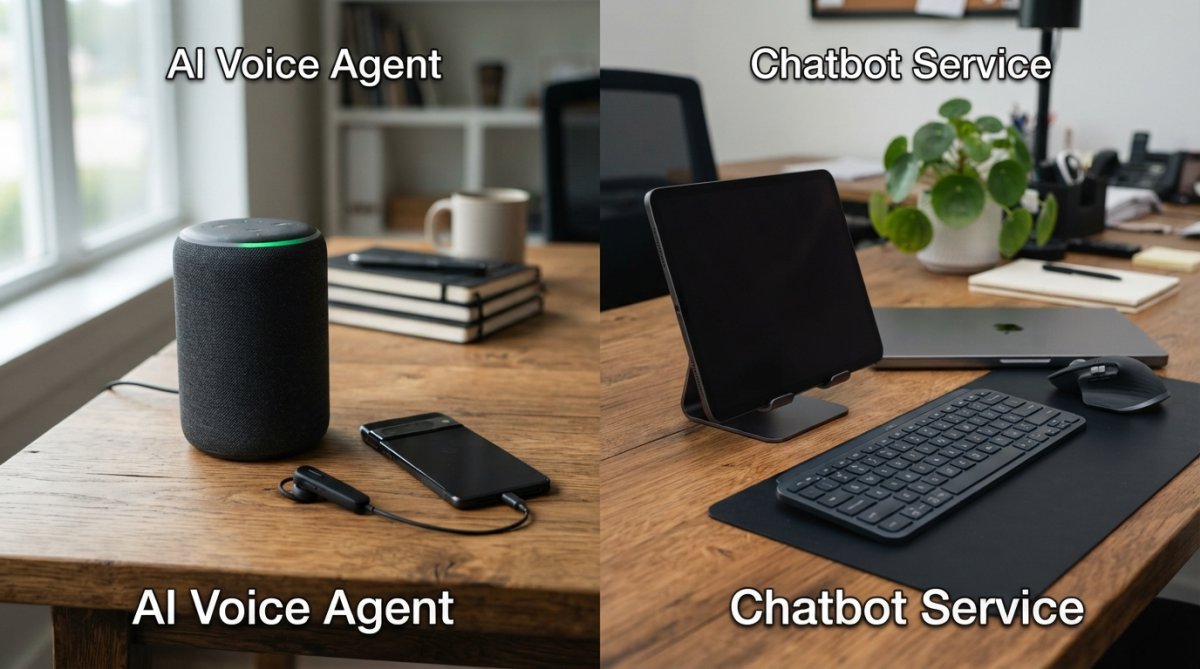
When evaluating ai voice agents vs chatbot service for your business, you're choosing between two fundamentally different technologies. Voice agents use large language models to reason through customer requests in real time, understand context, and execute workflows autonomously. Chatbots are rule-based systems that follow predefined decision trees, faster to deploy, cheaper upfront, but limited to scripted scenarios. Research from McKinsey's 2026 report on [AI in(/blog/benefits-of-ai-in-home-services) customer service | mckinsey.com] shows that businesses deploying autonomous AI agents handle 3x more inbound volume with the same headcount compared to rule-based systems.
For a 20-call-per-day plumbing company, a chatbot may suffice. For a growing e-commerce operation handling 500 daily inquiries, a voice agent is the difference between hiring additional staff and letting AI handle the overflow.
What Is an AI Voice Agent?
An AI voice agent is an autonomous system that answers phone calls, understands natural language requests, reasons through complex scenarios, and executes business logic without human intervention. It processes unstructured customer requests in real time, handles multi-stage task execution (qualify lead → check service area → schedule appointment → send confirmation), maintains context awareness, and integrates with backend systems via API orchestration.
A voice agent can answer a call about service availability, determine if the customer is in your service area, check technician schedules, propose appointment slots, and book the call, all without human involvement.
What Is a Chatbot Service?
A chatbot service is a rule-based conversational system designed to handle scripted interactions following predefined decision logic. Chatbots excel at routing customers, answering FAQs, and collecting basic information. They operate within guardrails, predetermined responses mapped to specific intents.
Core characteristics include intent recognition using NLU, predefined response flows for known scenarios, lower latency, minimal hallucination risk, and easier auditing. When a customer asks about business hours, the chatbot recognizes the intent and responds. When asked something outside its training, it typically escalates to a human.
Feature Comparison Table: Voice Agents vs Chatbots
| Capability | AI Voice Agent | Chatbot Service |
|---|---|---|
| Handles ambiguous requests | Yes, reasons through context | No, requires predefined paths |
| Multi-stage task execution | Autonomous, end-to-end | Limited to sequential steps |
| Latency | 2-5 seconds per response | 500ms-2 seconds |
| Hallucination risk | Requires guardrails and HITL | Minimal, rule-based |
| Training complexity | High (requires data + tuning) | Low (decision tree mapping) |
| Scalability (concurrent calls) | Scales to 1000+ simultaneously | Scales to 500+ simultaneously |
| Cost per interaction | $0.03-$0.12 | $0.01-$0.05 |
| Implementation time | 4-8 weeks | 1-2 weeks |
| Best for | Complex, variable requests | Repetitive, predictable queries |
How AI Voice Agents Work: Autonomous Decision-Making and Real-Time Processing
AI voice agents operate through a loop: listen → transcribe → understand → reason → act → respond. Automatic speech recognition converts audio to text with 95%+ accuracy. Natural language processing extracts intent and entities. The reasoning phase is where voice agents diverge from chatbots, the system evaluates multiple possible actions, considers business constraints, and selects the best path forward.

When deployed for home services, a voice agent checks real-time technician availability, confirms service area coverage, estimates pricing, and proposes appointment slots within a single conversation.
Reasoning and Context Awareness
Voice agents maintain context throughout a conversation. If a customer says "I need a plumber," then later says "Can you send someone tomorrow morning?", the agent remembers the original request and treats the follow-up as a refinement. This enables natural multi-turn conversations, clarification without repetition, and handling of conditional logic.
Workflow Automation and Multi-Stage Task Execution
Voice agents create real business value through end-to-end task execution. A single call can trigger multiple backend systems: check availability in your scheduling system, verify customer data in your CRM, process payment, send confirmation email, and log the interaction, all autonomously.
Chatbot Limitations: Why Rule-Based Systems Fall Short
Chatbots work well for defined, predictable interactions but fail when customers deviate from the script. A customer asking "Do you service apartment buildings?" might not match your FAQ about "commercial properties," and the chatbot either misroutes them or asks them to rephrase. A voice agent understands the intent and answers appropriately.
The core limitation is scope: you define every possible path, and the system executes only those paths. Requests that don't fit your decision tree either loop back to the customer or escalate to a human.
Intent Recognition and NLU Constraints
Chatbots use NLU to match customer input to predefined intents. The more edge cases that exist, the more intents you need to define. Voice agents handle this differently by understanding the underlying intent and acting on it, generalizing across phrasings rather than memorizing specific patterns.
Hallucinations and Guardrail Requirements
A critical difference emerges with hallucinations, instances where an AI system generates plausible-sounding but incorrect information. Chatbots don't hallucinate because they only return information you've explicitly programmed. Voice agents, being generative systems, can hallucinate.
This is why voice agents require guardrails: constraints that prevent the system from making commitments outside defined boundaries. Many organizations also implement human-in-the-loop (HITL) protocols where high-value or high-risk interactions are flagged for human review before execution.
AI Customer Service: When to Choose Voice Agents Over Chatbots
The choice depends on three factors: call volume, request complexity, and your tolerance for escalation.
Choose a chatbot if:
- You handle fewer than 50 calls per day
- Most calls fit into 3-5 standard scenarios
- You're willing to escalate non-standard requests to humans
- Your budget is tight and implementation speed matters
Choose a voice agent if:
- You handle 100+ calls per day
- Requests vary widely and require reasoning
- You need to reduce human agent workload for routine interactions
- You're willing to invest in setup and ongoing optimization
For a small plumbing company with 15-20 calls daily, a chatbot might suffice. At 150 calls daily, a voice agent becomes essential because human agents can't keep up.
High-Volume Call Handling and Scalability
Voice agents handle volume in a way chatbots can't. A voice agent scales nearly linearly because each call is processed independently. You can handle 1,000 concurrent calls with the same infrastructure that handles 100.
For e-commerce and home services, this matters during peak seasons. A surge in calls would require hiring temporary staff if relying on humans or chatbots. A voice agent scales automatically.
Complex Routing and Multi-Intent Scenarios
When a customer's request spans multiple intents, chatbots struggle. A customer might call saying "I want to schedule an appointment, but I have a question about your warranty, and I'd like a discount because I'm a repeat customer." A chatbot would handle each sequentially, while a voice agent addresses all three in one conversation.
AI Agent Use Cases: Real-World Applications for Home Services and E-Commerce
Lead Qualification and Service Area Routing
For home services, lead qualification is expensive work. A dispatcher spends 5-10 minutes on each inbound call determining if the customer is in-service area, if the job matches your capabilities, and if the customer's budget aligns with your pricing. A voice agent qualifies leads in 2-3 minutes, freeing your team to focus on closing deals.
For a company processing 200 calls per month, this eliminates 16-20 hours of dispatcher time monthly.
Omnichannel Integration and API Orchestration
When a voice agent is deployed, it connects to your scheduling system, CRM, payment processor, and email service. A customer booking an appointment automatically creates a calendar entry, logs the lead in your CRM, and sends a confirmation email, no manual data entry.
Voice AI Benefits: Cost Efficiency, Latency, and Human-in-the-Loop Protocols
The business case for voice agents hinges on three metrics: cost per interaction, time savings, and human agent capacity freed up.
Total Cost of Ownership and ROI Comparison
A voice agent costs between $0.03 and $0.12 per call depending on call length and complexity. A human agent costs $15-25 per hour, or roughly $0.25-0.50 per call. At scale, voice agents are 3-5x cheaper per interaction.
The real ROI comes from volume handling. A human agent handles 20-30 calls per day. A voice agent handles 500+ per day. For a 20-person home services company processing 300 leads per month, deploying a voice agent to handle lead qualification saves one full-time dispatcher role ($45K-60K annually) while improving lead response time from 4 hours to under 2 minutes.
Security, Compliance, and HITL Safeguards
Voice agents handling sensitive information require strong security and compliance frameworks. Your system must encrypt all data in transit and at rest, comply with HIPAA, PCI-DSS, or CCPA as applicable, implement audit logging for all agent actions, and support human review of sensitive interactions.
Human-in-the-loop (HITL) protocols are essential. High-value interactions should be flagged for human review before the agent commits to an action. According to Gartner's 2026 survey on AI governance, organizations implementing HITL protocols see 40% fewer customer complaints related to AI decisions compared to fully autonomous systems.
Implementation Roadmap: Deployment, Integration, and Support Considerations
Deploying a voice agent is more complex than deploying a chatbot, but the process is well-defined.
Managed vs. Self-Managed Solutions
A managed solution means your vendor handles infrastructure, updates, monitoring, and optimization. A self-managed solution means you deploy and maintain the infrastructure yourself. For most businesses, managed is the right choice to avoid the overhead of managing AI infrastructure and scaling.
API Integration with Existing Systems
Your voice agent needs to integrate with your scheduling system, CRM, payment processor, and other tools. Integration complexity varies:
- Simple integrations (read-only access to a database): 1-2 weeks
- Complex integrations (two-way sync with multiple systems, real-time updates): 3-4 weeks
- Custom integrations (building new APIs or data pipelines): 4-8 weeks
Before selecting a voice agent provider, audit your existing tech stack and confirm the provider supports integrations with your key systems.
Frequently Asked Questions
What is the main difference between an AI voice agent and a chatbot service?
AI voice agents use autonomous reasoning and real-time processing to handle complex, multi-stage customer interactions through natural conversation. Chatbots operate on rule-based, scripted logic designed for simple intent recognition and predefined responses. Voice agents can handle context awareness across conversations, make independent decisions, and execute workflow automation without human intervention. Chatbots typically require explicit decision trees and struggle with unstructured requests or nuanced customer needs.
When should a small business use an AI voice agent instead of a chatbot?
Choose a voice agent if you handle high call volume, need service area routing, or manage complex customer scenarios, like a plumbing company handling 15-20+ daily calls with location-specific service requests. Voice agents excel at lead qualification, appointment scheduling, and intelligent call routing. Chatbots work better for simple FAQs, order status checks, or basic customer service. If your business requires personalization, multi-intent handling, or 24/7 autonomous support without dropping calls, a voice agent delivers better ROI and customer experience.
What are the main limitations of traditional chatbots?
Traditional chatbots rely on rule-based systems that struggle with unstructured data, context awareness, and multi-stage workflows. They often hallucinate responses, misinterpret intent, and require extensive guardrails to prevent errors. Chatbots cannot autonomously execute business logic or make real-time decisions, they simply match keywords to predefined responses. They lack the reasoning capability to handle edge cases, service-specific routing, or complex customer scenarios. This makes them unsuitable for high-volume customer support or omnichannel integration without constant human oversight and manual system syncing.
How do AI voice agents handle complex customer issues better than chatbots?
AI voice agents use generative AI and LLM-based reasoning to understand context, recognize nuanced intent, and execute multi-stage tasks autonomously. They can qualify leads, assess service needs, route calls intelligently, and even schedule appointments without human handoff. Voice agents maintain conversation context across multiple turns, adapt responses based on customer tone and history, and integrate seamlessly with CRM systems via API orchestration. Chatbots cannot perform this level of workflow automation or decision-making, making voice agents essential for complex customer journeys in home services, e-commerce, and enterprise environments.
Are AI voice agents more expensive than chatbots, and what should I expect for total cost of ownership?
Cost depends on deployment model and complexity. Managed voice agent solutions handle all technical overhead, integration, and 24/7 support under one roof, eliminating the need for in-house expertise or constant system maintenance. Self-managed chatbots or voice platforms require development resources and ongoing monitoring. For small businesses handling 15-20 daily calls, a fully managed voice agent solution often delivers better ROI than hiring additional staff or maintaining multiple disconnected systems. Pricing varies based on call volume, features, and integration depth, contact a provider for a custom quote based on your specific business needs.
This article was written using GrandRanker